

Running a pool pump full-blast around the clock burns money fast, and most owners already know it. Variable speed pump controllers and the right support gear cut that waste by letting you match motor output to what the pool actually needs. The ten items below cover full pump replacements, controller add-ons, replacement lids and unions, flow meters, and motor covers, so you can build a smarter setup that fits your equipment and budget.
The Shortlist At A Glance

Jandy JEP-R ePump Digital Variable Speed Pool/Spa Pump Remote Control

357151 Pump Lid with 350013 O Ring Replacement for Pentair Whisperflo WFE

350157 Union Replacement for Pentair Superflo Variable Speed

Doheny’s 3/4 HP Above Ground Swimming Pool Pump

Blue-White FLOWREAD R-320 20-120 GPM Acrylic Flow Meter
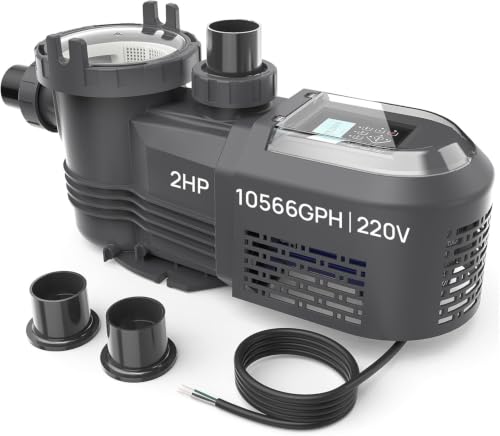
Aquastrong Variable Speed Pool Pump 2 HP 220V

Varpoolfaye 2.5HP Variable Speed Pool Pump 220V

Horizon Industries Pool Pump Cover Model 2PMC16
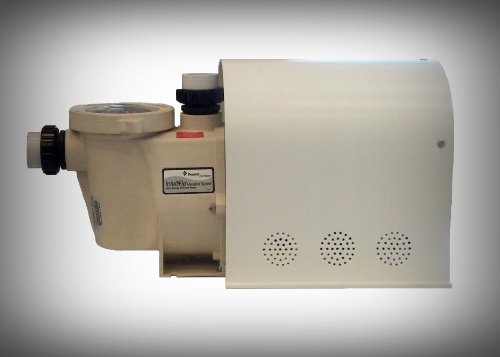
Horizon Industries Pump Motor Cover for Variable Speed Pool Pumps

Pentair 011028 IntelliFlo VS Pool Pump, Almond
The Strengths Of Each Pick
If your pool already runs a Jandy ePump, this remote control is the simplest way to squeeze more efficiency from a system you already own. Instead of walking out to the equipment pad to flip a setting, you adjust two timers and eight speeds from a labeled LCD screen, and a built-in freeze protection routine watches over the motor when temperatures dip. For most homeowners with an existing Jandy VS pump, that convenience is the whole point.
It can mount up to 200 feet from the pump, so the controller can live poolside, in a screened enclosure, or inside a utility room where you’d actually see it. A global RPM limiter caps top-end speed, which helps prevent accidental energy spikes. Compared to the Doheny’s entry-level pump on this list, this isn’t a replacement at all; it’s a control add-on for an established variable speed setup.
Advantages To Know
- Two programmable timers and eight speed presets, with custom labels on the LCD for easy recognition.
- Freeze protection logic that runs the pump automatically during cold snaps, helping prevent motor damage.
- Wired remote reach of up to 200 feet, so the controller doesn’t have to sit next to the pump pad.
- Global RPM limiter keeps the motor from being pushed beyond a safe ceiling during manual tweaks.
Worth Noting
- Compatibility is narrow: it’s a Jandy ePump accessory, so it won’t do anything for a Pentair, Hayward, or other-branded variable speed pump.
- Wired installation means routing a control cable, which a pool tech often handles faster than a DIYer.
Who Should Grab It
Pool owners already running a Jandy variable speed pump who want keypad-style speed and timer control without buying a new motor.
Look Elsewhere When
The Pentair 011028 IntelliFlo VS Pool Pump is the better match for anyone needing a complete pump replacement rather than a controller add-on.
A variable speed pump is only as airtight as its strainer lid, and a warped or cracked lid bleeds pressure the moment the motor ramps up. This replacement set is built for Pentair WhisperFlo, IntelliFlo VS, VS 3050, VF, and VS SVRS pumps, which covers a long list of in-ground variable speed installations. The kit pairs the 357151 lid with the 350013 O-ring, so you get both sealing surfaces in one order.
For most service calls, that’s exactly the bundle a pool tech or handy homeowner needs, since the O-ring is the part that usually gets tossed and forgotten. Once installed, the pump pulls prime cleanly again, and the variable speed controller can run through its full RPM range without the strainer pot drawing air. Versus the Jandy JEP-R remote covered above, this is a maintenance part, not a control upgrade; it matters because even the smartest controller needs a sealed lid to do its job.
Useful Highlights
- Direct fit for a wide spread of Pentair WhisperFlo and IntelliFlo VS pump models.
- Bundle includes the matching O-ring, removing the guesswork of sourcing a separate seal.
- Restores airtight strainer operation, which is critical for a variable speed pump to hold prime at low RPM.
Trade Offs
- Not a universal fit: it won’t help anyone running a Jandy, Hayward, or non-Pentair pump.
- Owners commonly report that the included O-ring should be lightly lubricated with silicone grease before seating to avoid a slow leak on first start.
Whose Shelf It Belongs On
Pentair WhisperFlo and IntelliFlo VS owners who need a fresh lid and seal during seasonal service or a strained-motor repair.
Skip It When
The Aquastrong 2 HP variable speed pump is the better pick for anyone replacing a complete pump rather than a single lid.
Variable speed pumps cycle their plumbing connections far more than single-speed units, and a tired union fitting can slowly weep water every time the motor shifts speeds. The 350157 union replacement is sized for Pentair SuperFlo VS and SuperMax pumps, which makes it a service staple for technicians who handle Pentair’s mid-range variable speed lineup. It’s a drop-in part designed to match OEM specifications, so the swap rarely requires re-plumbing.
For most pool owners tackling a winterization or rebuild, the appeal is simple: one part number covers the union kit you actually need. After installation, the pump-to-pipe connection handles low-RPM trickle cycles and high-RPM boost modes without the slow drip that costs water and prime. Compared to the Pentair 357151 lid reviewed above, this union works on the discharge side; together they round out a complete Pentair service kit.
A Strong Showing
- Direct-fit design for Pentair SuperFlo VS and SuperMax pumps, avoiding custom fabrication.
- Drop-in replacement that saves time on routine service or winterization work.
- Built to meet or exceed OEM specifications, so connections stay tight across speed changes.
Honest Caveats
- Model-specific, so it offers no value to anyone with a non-Pentair or older single-speed pump.
- Thread sealant and proper torque matter: skipping either can reintroduce the very leak the part is meant to fix.
Best Suited To
Pool techs and DIYers servicing a Pentair SuperFlo variable speed pump who want a clean, no-fabrication union swap.
Consider Something Else When
The Pentair 357151 lid kit is the better match for WhisperFlo owners who need a strainer-side seal instead of a plumbing union.
Above-ground pools don’t need the same flow muscle as a 20,000-gallon in-ground setup, and overspending on a 2 HP variable speed unit rarely makes sense for a 15-foot round. The Doheny’s 3/4 HP pool pump targets that smaller workload, with a stainless steel motor shaft inside a reinforced thermoplastic body. For most small-pool owners, that combination delivers the durability a backyard setup actually needs without the sticker shock of a full VS system.
The pump is built with the engineering priorities of an everyday above-ground owner: corrosion-resistant internals and a focus on low noise, which matters when the equipment sits ten feet from the back door. It’s not a variable speed unit, so you trade efficiency gains for a friendlier upfront cost, and the simpler single-speed design has fewer parts that can wear out. Next to the Jandy JEP-R remote reviewed earlier, this is a different category entirely: a basic replacement pump, not a controller upgrade.
Real Benefits
- Stainless steel motor shaft paired with a reinforced thermoplastic body for longer outdoor service life.
- 3/4 HP output sized correctly for small to mid-size above-ground pools.
- Quieter operation than older single-speed pumps thanks to its advanced internal engineering.
Points To Keep In Mind
- Not a variable speed pump, so you give up the energy savings that drive most VS controller shopping.
- Best matched to above-ground pools; in-ground owners will likely want more flow.
Feature Snapshot
Right Fit For
Above-ground pool owners who need a reliable replacement pump at a manageable cost and don’t need variable speed control.
Reach For A Different Pick When
The Aquastrong 2 HP variable speed pump is the better match for in-ground owners who want adjustable speeds and stronger flow.
You can’t tune a variable speed pump by guessing. The Blue-White FLOWREAD R-320 sits in a 2-inch ID PVC line and gives a live, visual readout of gallons per minute between 20 and 120 GPM, with an accuracy window of plus or minus 5 percent. For most pool owners running a VS system, that feedback is what turns a programmed schedule into real energy savings.
The acrylic meter body has its scale UV-printed on both sides, so it remains readable in direct sunlight at a typical equipment pad. Installation is unusually friendly: no unions, adapters, primer, or PVC cement are required, and you don’t need a hacksaw to fit it. Compared to the Doheny’s pump above, this is a measurement tool rather than a pump, and it’s the missing link for owners who want proof their VS settings are doing what the controller claims.
Where It Delivers
- Plus-or-minus 5 percent flow accuracy, which is precise enough to dial in VS pump speeds against actual demand.
- UV-printed scale on both sides of the acrylic body for readability in direct sun.
- 20 to 120 GPM range covers the full flow of most residential variable speed pool systems.
- Tool-free installation onto existing 2-inch ID PVC pipe.
Small Caveats
- Limited to 2-inch ID pipe, so retrofits on 1.5-inch plumbing require a reducer or a different meter.
- Acrylic body handles weather fine, but extreme impact can crack it, so plan placement away from foot traffic.
Made For
Variable speed pump owners who want to verify flow at different RPM settings and prove that their energy-saving schedule actually moves water.
Another Choice May Suit
The Jandy JEP-R remote control is a better fit for owners who just want easier speed changes and aren’t interested in flow telemetry.
Mid-size to large pools need a pump that can push serious water when called on, and the Aquastrong 2 HP VS unit is built for that workload. The motor spans roughly 1200 to 4000 RPM, with peak flow around 10,566 gallons per hour at the top end, and an integrated self-priming design plus a built-in filter basket. For most in-ground owners replacing an aging single-speed pump, that’s a substantial step up in capability without crossing into commercial pricing.
The headline draw is the energy claim, with the manufacturer pointing to roughly 80 percent lower consumption compared to traditional single-speed pumps at matched filtration duty. That kind of reduction depends on running low and mid speeds for most of the day, which is exactly the operating pattern variable speed controllers are designed for. Compared to the Varpoolfaye 2.5 HP pump reviewed later, this unit trades a bit of peak power for a more flexible speed range that suits broader residential use.
Good Reasons To Consider
- 2 HP motor with adjustable speed range from about 1200 to 4000 RPM, peaking near 10,566 GPH.
- Self-priming design simplifies startup and reduces troubleshooting on flooded suction lines.
- Built-in filter basket catches debris before it reaches the impeller, lowering maintenance frequency.
- Manufacturer-reported energy savings of up to 80 percent versus traditional single-speed pumps.
Where It Is Less Suited
- 220V wiring is required, so installation in homes with only 110V service needs an electrician.
- Peak flow is excellent, but very large in-ground pools may benefit from the extra headroom of a 2.5 HP unit.
Quick Facts
Perfect Match For
Owners of medium to large in-ground pools who want a 2 HP variable speed pump with strong peak flow and self-priming convenience.
A Better Fit Elsewhere
The Pentair 011028 IntelliFlo VS is worth a look for shoppers who want a longer-established VS platform with eight programmable speeds.
Some pools just need more muscle: longer plumbing runs, attached spas, water features, or simply a larger gallon count. The Varpoolfaye 2.5 HP variable speed pump is built for that workload, with a permanent magnet motor for smoother, quieter operation across its speed range. The variable speed design still lets you drop to low RPM for daily filtration, so you don’t pay a 2.5 HP energy bill every time the pump runs.
It’s rated for both in-ground and above-ground pools, which is unusual at this power level, and the permanent magnet motor is the kind of detail that tends to translate into less motor noise at slow speeds. Compared to the Aquastrong 2 HP unit above, the trade is straightforward: you get more headroom and torque in exchange for a slightly larger pump and the same 220V wiring requirement. For most large-pool owners, that extra half horsepower is the difference between a strained filter cycle and a calm, complete turnover.
What Stands Out
- 2.5 HP output provides extra headroom for large pools, attached spas, and water features.
- Permanent magnet motor runs more quietly and smoothly at low speeds than traditional induction designs.
- Compatible with both in-ground and above-ground setups, broadening its use cases.
- Variable speed operation still allows energy savings on daily filtration cycles.
Things To Consider
- 220V wiring required, so retrofits in homes without an existing 220V circuit add electrician costs.
- 2.5 HP is more than small above-ground pools need, and an oversized pump wastes energy even at low speeds.
Feature Card
Built With In Mind
Owners of large in-ground pools or pools with attached spas and water features who need a high-torque variable speed pump.
Not Your Match When
The Doheny’s 3/4 HP pump is the better fit for small above-ground pools where 2.5 HP is simply too much pump.
Sun and rain don’t care how expensive your pump was. The Horizon Industries 2PMC16 cover drops over a standard pump motor and uses white PVC to reflect solar heat, with the manufacturer reporting an average surface temperature drop around 15 degrees. For most equipment pad owners, that means the motor runs cooler during the hottest part of the day, which generally extends bearing and seal life.
The cover is sized for standard pool, spa, sprinkler, and well pump motors, so it covers a lot of backyard plumbing gear. It also covers the motor only, which is important because it leaves the strainer basket, unions, and drain plugs fully accessible for service. Compared to the Horizon Industries VS-specific cover reviewed next, this is the more universal option; the VS version is shaped for taller variable speed drives with electronics on top.
Notable Upsides
- White PVC shell reflects sunlight, lowering motor surface temperatures by an average of around 15 degrees.
- Fits standard pool, spa, sprinkler, and well pump motors in a single cover design.
- Motor-only coverage keeps strainer baskets, unions, and drain plugs accessible for routine service.
Possible Compromises
- Not shaped for the taller variable speed pump heads, so a VS owner needs the dedicated cover instead.
- White PVC will collect grime over time and may need a periodic rinse to keep its reflective benefit.
Who It Suits Best
Pool and spa owners with standard single-speed or basic pumps who want cooler motor surface temperatures and weather protection.
Swap It Out When
The Horizon Industries VS motor cover is the right pick for variable speed pump owners who need clearance for the drive electronics on top.
Variable speed pumps have a tall electronics drive sitting on top of the motor, and a standard pump cover simply won’t fit over it. This Horizon Industries cover is shaped for that exact profile, with extra height to clear the drive and protect it from direct sun and rain. The same white PVC construction is used to reflect solar heat off both the motor and the drive housing.
One of the better touches: no assembly is required, and the material can be cut or drilled for custom conduit or plumbing pass-throughs. For most VS pump owners, that means the cover goes on in minutes and adapts to whatever plumbing configuration the equipment pad already has. Compared to the standard 2PMC16 cover reviewed above, this is the version to pick when your pump has a drive head, not just a plain motor.
Well-Handled Touches
- Profile designed to clear the drive electronics on top of a variable speed pump motor.
- White PVC reflects sunlight, helping keep the motor and drive cooler during long summer runs.
- Protects both the motor and the variable speed drive from direct sun and rain exposure.
- No assembly required, and the material can be cut or drilled for custom plumbing or conduit routing.
Smaller Limitations
- Specific to VS pump silhouettes, so it won’t fit a low-profile standard pump as cleanly as the 2PMC16.
- Custom cuts for conduit pass-throughs require careful measuring, and over-trimming weakens the cover edge.
Who Will Love This
Variable speed pump owners who want a single cover shaped to protect both the motor and the drive electronics on top.
Where Another Pick Suits Better
The Horizon Industries 2PMC16 is the better fit for standard pump motors that don’t have a drive head on top.
When a pool owner is replacing an entire pump rather than tweaking a controller, the Pentair 011028 IntelliFlo VS is the established name in residential variable speed. The 011028 replaced the older 011018 drive and software, and it’s one of the more recognized VS platforms on the market. Eight programmable speed settings and a built-in timer give you real control over daily filtration, heating, and feature cycles.
The manufacturer’s published efficiency claim reaches as high as 90 percent savings versus traditional single-speed pumps, which only materializes when you actually run low speeds for the bulk of the day. For most pool owners, the practical draw is the brand’s service network and the long track record of the IntelliFlo platform. Compared to the Aquastrong 2 HP pump covered earlier, the Pentair trades some peak horsepower for a more mature controller interface and broader technician familiarity.
The Helpful Details
- Eight programmable speed settings, allowing precise matching of output to filtration, heating, and feature demand.
- Built-in timer automates speed changes throughout the day, reducing manual adjustments.
- Updated 011028 drive replaces the older 011018 platform, with current software support.
- Manufacturer-claimed efficiency of up to 90 percent versus traditional single-speed pumps.
Trade-Offs To Consider
- Higher upfront cost than basic pumps, which only pays back when low-speed schedules are actually used.
- Requires a 230V circuit, so installation in homes with only 115V service needs electrical work first.
Spec Overview
Perfect Match For
Whole-pool owners ready to commit to a full variable speed replacement and willing to invest in a long-established platform.
Look Elsewhere When
The Aquastrong 2 HP pump is the better value pick for shoppers who want strong peak flow at a lower upfront cost.
Picking The Right Variable Speed Pool Pump Controller And Support Gear
Matching Motor Power To Pool Size
The first thing to size correctly is horsepower, which is the pump’s peak mechanical output. A small above-ground pool rarely needs more than 3/4 to 1 HP, while a mid-size in-ground typically lives in the 1.5 to 2 HP range. Larger in-ground pools with attached spas or water features usually justify 2.5 HP or more. Oversizing wastes energy; undersizing starves the filter and heater. When in doubt, the pool’s gallon count and plumbing run length matter more than advertised peak GPH, because longer pipe runs and elevation changes eat into effective flow.
Speed Range And Programming Depth
The whole point of a variable speed pump is the ability to drop to lower RPM for daily filtration, then ramp up for heating or water feature demand. A pump with at least 3 to 4 usable speed presets covers most residential schedules, while 8 presets give finer control over heating, cleaning, and spa modes. Built-in timers are a major convenience, since they automate the speed transitions that otherwise have to be made manually. For most owners, a pump with at least one slow filtration speed and one mid-speed cleaning speed is the practical minimum.
Plumbing Compatibility And Electrical Requirements
Before anything else, check voltage and pipe size. Most VS pumps require 220V or 230V service, and homes with only 110V wiring need an electrician before the pump can be installed. Pipe size matters too: a flow meter or pump lid that fits 2-inch ID PVC will not work on 1.5-inch plumbing without a reducer. Replacement lids and unions should always be matched to the specific pump model, since Pentair WhisperFlo, SuperFlo, and IntelliFlo parts rarely cross over cleanly.
Controls, Telemetry, And Long-Term Care
Remote controllers, flow meters, and motor covers are the small add-ons that turn a pump into a managed system. A flow meter proves the pump is actually moving the gallons per minute you expect, which is the only honest way to validate a variable speed schedule. A motor cover, especially one shaped for a VS drive, keeps the electronics cooler and out of direct rain. These aren’t mandatory, but they extend service life and make tuning the system far less guesswork-heavy.
Key Considerations Across These Picks
Where Shoppers Go Wrong
The most common slip is buying the highest horsepower pump on the shelf because the spec sheet looks reassuring. Larger pumps cost more to run even at low speed, and an oversized motor cycling at minimum RPM often delivers worse filtration than a properly sized pump at mid speed. Another common trap is ignoring electrical: a 220V pump dropped onto a 110V circuit either won’t run at all or trips breakers constantly. Finally, shoppers occasionally treat a controller or cover as a substitute for a real pump, when those parts only work alongside a working motor.
When Paying More Pays Off
Higher-tier variable speed pumps earn their premium through a more efficient permanent magnet motor, deeper programming options, and longer service support. The savings show up in two places: lower monthly energy use when the pump runs at low speed for many hours, and a longer useful life because the motor spends less time at peak output. For pools that run a pump 8 to 12 hours a day, that efficiency gap compounds quickly. The upgrade is easiest to justify on larger in-ground pools where the pump is a major line item on the electric bill; small above-ground pools rarely recoup the difference.
Frequently Asked Questions
How much can a variable speed pool pump actually save on energy?
Most homeowners see meaningful reductions on their electric bill by running the pump at low RPM for daily filtration, since slower speeds draw far less power. The exact figure depends on the schedule, but running the pump at its lowest useful speed for most of the day is the main driver.
Do I need an electrician to install a variable speed pool pump?
In most cases, yes. Variable speed pumps typically require 220V or 230V service, and many homes only have 110V wiring at the equipment pad. A licensed electrician can add the proper circuit and breaker, and local code may require a permit.
Can I use one controller to run multiple pool pumps?
Standard pump controllers like the Jandy JEP-R are designed to manage a single compatible pump, not multiple units across different brands. Whole-pool automation systems handle multi-pump setups, but they’re a different category of equipment.
How do I know if my pump is sized correctly for my pool?
A correctly sized pump turns over the entire pool volume at least once every 8 to 12 hours at a moderate speed setting. If the pump struggles to prime, can’t run a heater and cleaner at the same time, or runs at full speed all day, the sizing is probably off.
Are motor covers really necessary for variable speed pumps?
A cover isn’t strictly required, but it does keep the motor and the drive electronics cooler and out of direct rain, which generally extends service life. The white PVC covers on this list are the most common pick because they reflect solar heat.
The Takeaway
Variable speed pool pump controllers and the gear around them pay you back the moment you stop running a motor flat-out all day. Match the pump to the pool, verify the flow with a meter, and protect the drive with a fitted cover, and the system will quietly do its job for years. Start with the Pentair 011028 IntelliFlo if you want a full replacement, the Aquastrong 2 HP for strong mid-size value, or the Jandy JEP-R remote if your pump is already variable speed and just needs better control.


