

Routine shocking keeps pool water safe, but the chemistry gets messy once you compare dichlor, cal-hypo, and non-chlorine oxidizers side by side. Pool owners who care about cyanuric acid buildup, calcium scaling, or chloramine odor all land on slightly different products. The five picks below cover those camps, from a pure 99.5% sodium dichlor bulk bucket to a cal-hypo workhorse and a chlorine-free weekly oxidizer that lets swimmers back in fast.
The Essentials At A Glance

Doheny’s Chlorine-Free Oxidizing Shock 12 x 1lb Bags
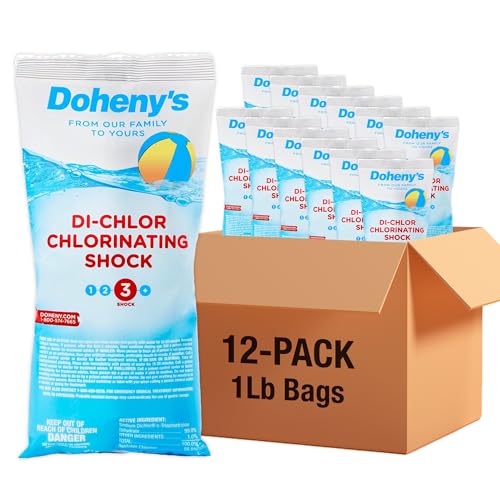
Doheny’s Di-Chlor Shock 56% Stabilized Chlorine 12 x 1lb Bags

Doheny’s Super Pool Shock 12 x 1 Lb Bags

Doheny’s Super Pool Shock 68% Cal-Hypo 24 x 1lb Bags

Doheny’s Di-Chlor Granular Chlorine 99.5% Sodium Dichlor 50lb Bucket
Taking A Closer Look At The Options
This is the pick for households that shock every week and hate the “no swimming” wait. Chloramines are the spent chlorine byproducts that smell like a public indoor pool, and this granular formula oxidizes them without adding more free chlorine on top. For backyards where a kid’s birthday party is always 20 minutes away, that speed matters.
It also doubles as a maintenance tool between heavier chlorine shocks. Pool owners with a stable cyanuric acid level, or CYA, and a steady sanitizer routine use it to knock down combined chlorine without pushing the free chlorine reading higher. It’s not a replacement for true dichlor in opening or closing situations, but it earns its slot on the shelf.
Notable Gains
- Swim-ready window of about 15 minutes, far shorter than a standard chlorine shock
- Targets chloramines directly, so the “chlorine smell” drops after each dose
- Won’t add to CYA levels, keeping stabilizer readings in check long-term
- Fast-dissolving granular form means no cloudy residue after broadcast dosing
Honest Caveats
- Won’t raise free chlorine on its own, so it pairs with a base sanitizer
- Stored in warm garages, the powder can clump over a full season
- Not designed for green-pool algae recovery; reach for dichlor or cal-hypo instead
Who It Suits Best
Backyard owners on a regular chlorination schedule who want a quick weekly oxidizer without changing the water’s stabilizer or hardness profile.
A Better Fit Elsewhere
Pool owners fighting a stubborn algae bloom should grab the Doheny’s Super Pool Shock 12 x 1 Lb Bags, which has the chlorine strength to clear contaminated water fast.
Where the chloramine oxidizer above cleans up after the fact, this dichlor formulation does the actual sanitizing work. It contains 56% stabilized chlorine, which means the CYA it carries helps shield the active chlorine from UV breakdown, a real benefit in sunny, uncovered pools. The “calcium-free” label also signals no hardness contribution, so the water stays clear after dosing.
It splits the difference between the 50-pound bucket for serious operators and a small maintenance bag. Twelve 1-pound pouches are easy to store, dose, and rotate through. For saltwater pools that already run a steady CYA target, this acts as a clean supplemental shock when the salt cell can’t keep up after a heat wave or a heavy bather weekend.
A Few Highlights
- Calcium-free formula avoids the white scaling that hardens tiles and heaters
- Granular form dissolves quickly with no gritty leftovers on the floor
- Safe for both saltwater and traditional liquid chlorine pools
- Per-bag sizing simplifies measuring at the standard 1 pound per 10,000 gallons
Points To Note
- Does contribute to CYA over months of use, requiring occasional partial drain and refill
- Not the strongest single-dose shock for a green pool; you’ll likely need multiple rounds
Best Suited To
Saltwater pool owners and liquid chlorine users who want a residue-free shock that won’t push calcium hardness upward over a typical season.
Swap It Out When
Anyone chasing a one-and-done algae knockdown should consider the Doheny’s Super Pool Shock 12 x 1 Lb Bags, which carries a higher available chlorine concentration for harder water problems.
This is the roughneck of the lineup. Cal-hypo, short for calcium hypochlorite, is the same chemical that commercial pool services dump in for fast, heavy chlorination. At 68% calcium hypochlorite and 65% available chlorine, it lifts free chlorine readings in a single pass, which is exactly what a neglected or algae-tinted pool needs.
The 12-bag case is the right size for a one-time recovery rather than a season-long supply. After the initial knockout dose, most pool owners drop back to a daily chlorination routine or a maintenance dichlor product. Reach for this when the water has turned hazy, when a heatwave has overwhelmed the regular sanitizer, or when closing a pool for winter in a cold climate.
Everyday Perks
- Strong single-pass chlorine lift for cloudy or algae-affected water
- Pre-measured 1-pound bags remove the guesswork from dosing
- Compatible with most standard residential pool chemistry programs
Worth Bearing In Mind
- Adds calcium to the water with every dose, so long-term use can push hardness up
- Raises pH, often requiring a balancing step after shocking
- Strong odor during application; the surrounding deck will smell like an indoor pool
Right Fit For
Pool owners dealing with sudden algae growth, post-storm contamination, or seasonal openings where a heavy first shock is part of the routine.
Where A Sibling Pick Shines
Those maintaining soft water long-term should choose the Doheny’s Di-Chlor Shock 56% Stabilized Chlorine 12 x 1lb Bags, which keeps calcium out of the picture entirely.
Same chemistry as the previous pick, simply scaled up. The 24-bag case suits households that shock weekly through the warmer months, or commercial-adjacent setups like a rental property or community pool that runs through heavy bather loads. The granular form dissolves quickly when broadcast across the surface, so there’s minimal brushing required after dosing.
Pool owners in regions with high evaporation, where calcium hardness climbs anyway, should monitor the water test results closely with this one. It will do the sanitation job well, but it also adds to the same hardness reading that hot, dry climates already push upward. In most backyards, the trade-off is acceptable because the convenience of fewer shopping trips outweighs the long-term hardness buildup.
Where It Delivers
- Large case format reduces reordering over a long swim season
- Same 68% cal-hypo concentration as the smaller case, so the dosing math stays familiar
- Quick-dissolving granules suit routine weekly use
Factors To Consider
- Bulk quantity means finding dry, cool storage for 24 individual 1-pound bags
- Calcium contribution makes it less ideal for very hard source water
Made For
Pool owners with a high-traffic or commercial-style pool who shock on a regular cadence and want fewer restocking trips through the season.
Reach For A Different Pick When
Someone dosing once a month for a small residential pool will oversupply themselves; the Doheny’s Super Pool Shock 12 x 1 Lb Bags is a better size match.
This is the pure-dichlor option for the hands-on pool owner who likes a single product to handle three jobs: daily sanitizing, weekly shocking, and algae prevention. At 99.5% sodium dichlor with 56% stabilized chlorine, it’s the same active ingredient the bagged version uses, just supplied in a 50-pound bucket that covers a full season of routine care for mid-sized pools.
Calcium-free and residue-free, it won’t cloud the water or leave white dust on the steps, which matters in darker plaster pools where cloudiness is more visible. The trade-off is storage footprint, since a 50-pound pail takes up real floor space in a shed. For households running a full dichlor-based program, though, the per-pound cost difference versus bagged shock is the main draw.
What Pays Off
- 99.5% sodium dichlor concentration offers a high-purity active ingredient
- Pulls double and triple duty as sanitizer, shock, and algaecide
- Calcium-free formula keeps the water clear and the surfaces stain-free
Some Limits To Know
- 50-pound bucket requires dry, sealed storage to prevent clumping
- Scoop and measure by hand, since the bucket doesn’t come with pre-portioned bags
Who Should Grab It
Pool owners who run dichlor as their primary sanitizer and want one bulk container to handle sanitizing, shocking, and algae prevention for the whole season.
Consider Something Else When
Anyone with limited dry storage or a small spa-style pool should choose the Doheny’s Di-Chlor Shock 56% Stabilized Chlorine 12 x 1lb Bags for easier handling.
Shopping For The Right Shock Without The Guesswork
Choosing pool shock starts with the source water and the sanitizer already in use. Hard water regions, where calcium readings sit above 400 ppm, pair better with calcium-free dichlor to avoid scale buildup on heaters and tile. Soft water regions, where calcium sits below 200 ppm, can absorb cal-hypo shocks without the same risk, and the stronger concentration clears algae faster.
Match the shock to the sanitizer program. Saltwater chlorine generators already maintain a baseline of free chlorine, so a non-chlorine oxidizer handles weekly chloramine cleanup without nudging the salt cell past its duty cycle. Trichlor tabs and liquid chlorine users tend to lean on dichlor for routine shocking and save cal-hypo for the heavy recovery moments.
Size the package to the dosing frequency. A 50-pound bucket only pays off when the pool actually gets shocked weekly across a four-to-five-month swim season. Smaller households with light weekend use waste product when they buy bulk, because chlorine degrades in storage over a full year, even in sealed containers. Twelve-bag cases hit the middle ground for active maintenance, while six-bag cases suit very small pools or first-time buyers testing a product.
CYA deserves a quick test before committing to a stabilized product. Cyanuric acid works like sunscreen for chlorine, but levels above 100 ppm start to over-shield it, weakening sanitizing power. Run a fresh test, and if CYA is already elevated, a non-chlorine oxidizer or a cal-hypo option avoids pushing the stabilizer higher.
What Sets Each Tier Apart In Real Pools
Where Shoppers Go Wrong
The most common slip-up in this category is treating “shock” as one product type. Dichlor, cal-hypo, and non-chlorine oxidizers do different jobs, and substituting one for another can either overshoot the CYA reading or underperform against an algae bloom. Match the product to the problem instead of grabbing whatever is on sale.
Storing shock in a humid garage or shed is another quiet mistake. Chlorine compounds absorb moisture over time, which clumps the granules and weakens the active ingredient. A sealed, dry container in a climate-stable corner of the home keeps product strength consistent from the first bag to the last.
When Paying More Pays Off
Higher-tier options in this category usually buy a higher active-ingredient concentration or a calcium-free formulation. For a pool with hard source water, a calcium-free dichlor saves money over time by avoiding a premature drain and refill to fix the hardness reading. For heavy algae situations, the stronger cal-hypo concentration finishes the job in one pass instead of three, which uses less total product and less time.
Bulk packaging, like the 50-pound bucket, also earns its premium when the pool actually consumes the volume within a season. The per-pound cost drops noticeably, and there’s only one ordering trip to plan around.
Frequently Asked Questions
What’s the difference between sodium dichlor and calcium hypochlorite?
Sodium dichlor is a stabilized chlorine with built-in CYA that resists UV breakdown, while calcium hypochlorite is an unstabilized, stronger chlorine that adds calcium to the water. Pick dichlor for soft water and routine use, cal-hypo for harder shock jobs and high calcium source water.
Can sodium dichlor be used in saltwater pools?
Yes, sodium dichlor is compatible with saltwater chlorine generator pools and works well as a supplemental shock when the salt cell can’t keep up with demand. It adds a small amount of CYA, so monitor stabilizer levels over the season.
How often should a residential pool be shocked?
Most residential pools benefit from a weekly shock during heavy use or hot weather, and a biweekly shock during cooler months. Heavy bather loads, recent rain, or visible algae all call for an extra dose outside the normal schedule.
Is a non-chlorine oxidizer the same as a regular shock?
No, a non-chlorine oxidizer breaks down chloramines and “refreshes” existing chlorine, but it does not raise free chlorine on its own. It’s a maintenance tool, while dichlor and cal-hypo are full sanitizing shocks.
How should pool shock be stored between uses?
Store pool shock in a cool, dry, sealed location away from direct sunlight and moisture. Keep bags in their original containers or in a lidded plastic bin, and avoid stacking heavy items on top of the pouches to prevent compaction.
Bottom Line
The right pick comes down to source water, sanitizer type, and how often the pool actually gets shocked. Hard-water households and saltwater pools do well with the calcium-free dichlor options, while tougher algae jobs call for the cal-hypo strength of the Super Pool Shock line. For routine chloramine cleanup between heavier shocks, the chlorine-free oxidizer keeps the water fresh without raising CYA. Match the product to the water, and the rest of the season takes care of itself.


