

Swapping out a tired pool pump or sizing one for a new build is one of those jobs that lives or dies by the GPH number on the spec sheet. Pool owners chasing faster turnover, cleaner water after a storm, or smoother running with a saltwater system tend to end up in the same place, reading pump curves and wondering whether the difference between 6,604 and 10,032 GPH really matters. This roundup pulls together six high flow pool pumps that span in-ground replacement parts, dual-speed flexibility, and straightforward single-speed workhorses, with notes on who each one actually suits in a real backyard setup.
The Picks In Brief

Pentair Diffuser 35-5188 Pac Fab 355188

Aquastrong Riptide 3 HP Dual-Speed Pool Pump

Aquastrong Riptide 1.5 HP Dual-Speed Pool Pump
Aquastrong Riptide 2 HP Dual-Speed Pool Pump
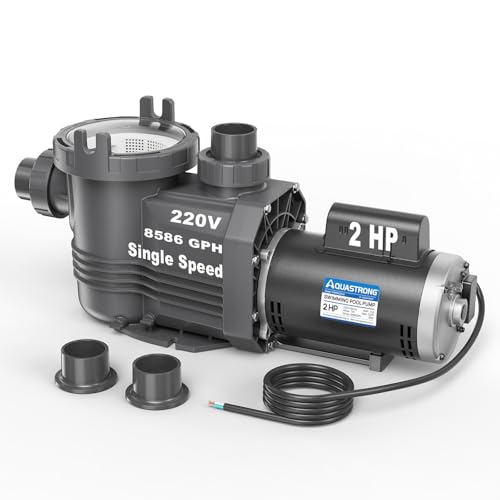
Aquastrong Riptide 2 HP Single-Speed Pool Pump

Aquastrong Riptide 1.5 HP Single-Speed Pool Pump
Why These Options Stand Out
This listing is in a different lane from the rest of the roundup, and that’s the whole point. The Pentair Diffuser 35-5188 Pac Fab 355188 is a replacement diffuser (a component that redirects water flow inside the pump housing) rather than a full pump, sized for the Challenger high-pressure in-ground series covering models CHII-NI-3/4F, CHII-NI-1F, CHII-NI-1A, and CHII-NI-1-1/2A.
For anyone already running a Challenger pump and noticing pressure drops, cavitation (air bubbles forming inside the pump that erode metal parts and reduce flow), or strange rattling from the housing, swapping the diffuser is a direct way back to the original flow behavior. It comes in at roughly 15 inches long, 15 inches tall, and 7-1/2 inches wide, so it’s worth a quick tape-measure check against the equipment pad before ordering.
Points In Its Favor
- Factory-original part that restores the Challenger pump’s rated flow without rewiring anything.
- Catalog numbers 355188 and 5002-06A cross-reference cleanly for fast lookups at parts counters.
- Physical dimensions make the swap a weekend task for anyone comfortable around pump housings.
Things To Consider
- Only useful if the existing pump is a Challenger; mismatched housings will not seat properly.
- Pressure symptoms can also point to a worn impeller (the spinning blade that pushes water through the pump) or a leaky lid seal, so the diffuser may not always be the root cause.
- Housing bolts on older Challenger units sometimes seize, so a penetrating lubricant on hand speeds the job.
Feature Snapshot
Who It Suits Best
Owners of legacy Pentair Challenger pumps chasing a factory-original diffuser swap to restore rated flow.
Consider Something Else When
The Aquastrong Riptide 3 HP Dual-Speed Pool Pump is a smarter pick for anyone replacing the whole pump rather than repairing an existing Challenger.
The Aquastrong Riptide 3 HP Dual-Speed Pool Pump tops the GPH chart for this roundup at up to 10,032 GPH on high, with a low setting closer to 4,755 GPH. That dual-speed setup is genuinely useful: cranking it up for vacuuming, post-storm clearing, or running water features, then dropping into low for the long daily circulation stretch where energy use matters more than flow.
Under the hood sits a pure copper 3 HP motor (horsepower, a measure of motor output) running on 220V/60Hz, paired with a self-priming housing and a filter basket that catches debris before it reaches the impeller. Pool owners with large in-ground setups, attached spas, or water features pulling off the same loop will appreciate having the extra headroom without the motor running flat out all day.
Benefits That Matter
- 10,032 GPH on high turns a green pool recovery or a heavy vacuum job from an all-day chore into a quick one.
- Low-speed mode at roughly 4,755 GPH noticeably reduces the hum on the equipment pad compared to single-speed workhorses like the Aquastrong Riptide 2 HP Single-Speed Pool Pump.
- Pure copper motor windings are widely reported to hold up better to heat cycling than aluminum alternatives in the same category.
Honest Caveats
- 220V wiring means most households need an electrician to confirm the equipment pad has the correct circuit, and retrofitting is sometimes needed.
- At 3 HP on high, the pump can overpower a small above-ground filter if paired with a smaller cartridge system, so a flow check on the existing plumbing pays off.
- Filter basket still needs to be cleared routinely under heavy use, and at this flow rate debris collects fast.
Whose Shelf It Belongs On
Large in-ground pool owners who want the highest GPH in the roundup and have 220V service ready to feed it.
Skip It When
Smaller above-ground setups that don’t need this much flow should look at the Aquastrong Riptide 1.5 HP Single-Speed Pool Pump for a friendlier fit.
Stepping down to a 1.5 HP motor lands the Aquastrong Riptide 1.5 HP Dual-Speed Pool Pump in a much friendlier neighborhood for typical backyard pools, with up to 6,604 GPH on high and roughly 3,302 GPH on low. The same pure copper motor and self-priming housing carry over from the bigger Riptide models, which is a nice consistency for anyone standardizing equipment across multiple pools.
Most mid-size in-ground pools fall into the GPH range this pump delivers on high, and the low setting is enough for daily turnover without pushing the motor. Compared with the 3 HP version earlier in this list, the 1.5 HP trades peak flow for quieter operation, smaller current draw, and an easier match with standard 220V residential wiring.
What Helps Most
- Dual-speed flexibility means the same pump can handle vacuuming and 24-hour circulation without burning extra watt-hours.
- At 6,604 GPH on high, it lines up with the recommended flow for most 15,000-to-25,000-gallon residential pools.
- Self-priming design saves the manual prime routine after filter cleanouts or long idle stretches.
Points To Note
- Still 220V, so older above-ground installs on 110V outlets will need electrical work first.
- Lower peak GPH means large debris recovery takes longer than it would on the 3 HP sibling.
Quick Facts
Made For
Mid-size in-ground pool owners who want dual-speed flexibility without stepping up to a 3 HP motor.
Another Choice May Suit
Pool owners needing higher peak flow for large or heavily used pools should consider the Aquastrong Riptide 2 HP Dual-Speed Pool Pump instead.
The middle child of the Riptide family, the Aquastrong Riptide 2 HP Dual-Speed Pool Pump, sits at up to 8,586 GPH on high and roughly 4,427 GPH on low, with the same 220V pure copper motor platform as its 1.5 HP and 3 HP siblings. For a lot of households, the 2 HP rating is the sweet spot between the gentle 1.5 HP unit and the higher-draw 3 HP workhorse.
It handles bigger in-ground pools, attached spa spillovers, and solar heating loops without maxing out the way the 1.5 HP would. Where the 3 HP version pulls hard enough to overwork a small filter, this 2 HP pump tends to match a wider range of mid-size filter systems without forcing plumbing changes.
Everyday Advantages
- 8,586 GPH is enough to keep up with attached spa spillovers, solar panels, and water features on the same loop.
- Low setting at 4,427 GPH is a smart default for overnight circulation, which trims the kilowatt-hour cost over a season.
- Filter basket is large enough that homeowners report less frequent rinsing under typical backyard debris loads.
Possible Compromises
- Heavier than the 1.5 HP unit, so the concrete pad needs to be flat and accessible before install.
- Peak draw is higher than the 1.5 HP, so a quick check of the breaker rating (the amperage capacity of the home’s circuit breaker) before ordering prevents nuisance trips during startup surges.
Spec Overview
Right Fit For
Mid-to-large in-ground pool owners with accessories on the same plumbing who want stronger flow than 1.5 HP but not the draw of 3 HP.
Where Another Pick Suits Better
For shoppers who don’t need dual-speed control, the Aquastrong Riptide 2 HP Single-Speed Pool Pump offers the same peak flow with simpler operation.
The Aquastrong Riptide 2 HP Single-Speed Pool Pump takes the same 8,586 GPH peak flow and the same pure copper 2 HP motor as the dual-speed sibling, but drops the low-speed switch in favor of straightforward, full-time operation. For pool owners who never touch a pump timer and just want a reliable, full-power unit, that simplicity is the entire feature.
It pairs with the same filter basket, self-priming housing, and 220V/60Hz platform as the rest of the Riptide series, which simplifies parts and routine maintenance across multiple pumps. Set it on a basic mechanical or digital timer and the daily routine looks the same year after year.
A Strong Showing
- 8,586 GPH peak is identical to the dual-speed 2 HP model, so it carries the same flow headroom.
- Single-speed operation removes the mode-switching step, which is a real plus for older timers without speed relays.
- Pure copper motor and self-priming housing are consistent with the rest of the Riptide line, simplifying spare parts.
Trade Offs
- Runs at full power continuously, so the energy savings a low-speed setting offers on the dual-speed Aquastrong Riptide 2 HP Dual-Speed Pool Pump are not available here.
- Still 220V, so older 110V-only equipment pads will need an electrician before install.
Best Suited To
Pool owners who want strong single-speed performance without managing a second speed setting or upgrading their timer.
Where A Sibling Pick Shines
Anyone interested in trimming long-term energy use should consider the Aquastrong Riptide 2 HP Dual-Speed Pool Pump for its low-mode option.
The Aquastrong Riptide 1.5 HP Single-Speed Pool Pump caps the roundup at 6,604 GPH and the simpler end of the series. It’s the smallest member of the Riptide line, and that smaller footprint matters for tight equipment pads, smaller above-ground pools, and setups where space is more limited than flow requirements.
The 1.5 HP pure copper motor and 220V/60Hz platform stay consistent with the rest of the lineup, which means shared maintenance habits and easily matched spare parts. For a smaller in-ground pool or a well-matched above-ground system, it tends to be the right size, neither under- nor oversized.
What Makes Sense
- At up to 6,604 GPH, this pump lines up with the flow needs of smaller in-ground and many above-ground pools.
- Smaller housing footprint is easier to retrofit on cramped equipment pads where the 3 HP version won’t fit.
- Self-priming design and filter basket match the rest of the Riptide series, so maintenance stays familiar.
Less-Strong Areas
- Single-speed only, so the energy savings available on the Aquastrong Riptide 1.5 HP Dual-Speed Pool Pump are off the table.
- May feel underpowered for pools with attached spas or multiple water features pulling from the same plumbing.
Who Should Grab It
Shoppers with smaller in-ground or right-sized above-ground pools who want a manageable 1.5 HP pump without paying for extra capacity.
Look Elsewhere When
Anyone running a larger pool or wanting dual-speed control should step up to the Aquastrong Riptide 2 HP Dual-Speed Pool Pump for stronger flow and flexibility.
What Matters When Picking a High Flow Pool Pump
Pool size and turnover are the first two filters. A pump that pushes 6,604 GPH moves the entire volume of a 15,000-gallon pool in well under a day, while a 10,032 GPH unit clears a 25,000-gallon pool in roughly two and a half hours, which is helpful after a storm or heavy pollen drop. Matching the pump to the pool’s actual gallons, not its rated maximum, keeps the motor from running against closed valves.
Voltage is the second gatekeeper. Every Riptide in this roundup runs on 220V, which most homes route to the equipment pad already, but older above-ground setups sometimes sit on 110V. Confirming the breaker size and the wire gauge before ordering prevents an electrician’s day-of-install scramble.
Motor material and housing design play into long-term reliability. Pure copper motor windings tend to handle heat cycles better than aluminum alternatives, and a self-priming housing saves the manual prime routine after filter cleanouts. Dual-speed pumps cost a bit more up front, but the low setting is where the kilowatt-hour savings stack up over a full swim season.
Key Considerations Across These Picks
Common Shopping Slip Ups
The most common mistake is buying by horsepower alone instead of by GPH at the pool’s real head (the total resistance the pump has to push against, including pipes, filters, and fittings). A 3 HP pump running against undersized plumbing can actually deliver less water than a 1.5 HP pump with the right pipe diameter. Always cross-check the pump curve (a graph showing flow rate at different pressure levels) against the existing plumbing before committing to a model.
Another frequent misstep is forgetting to match the filter. A high flow pump paired with a small cartridge filter just pushes debris back into the pool faster. Filter area and pump output should rise together.
What The Higher Tier Buys
Stepping from a 1.5 HP single-speed unit to a 2 HP or 3 HP dual-speed model buys two things: more peak GPH for heavy cleaning days, and a low-speed mode that runs quieter and uses less energy during long stretches of routine circulation. For pool owners who run the pump 8 to 12 hours a day, that low-speed mode is where the long-term savings live, which is the case for spending up if the budget allows.
Frequently Asked Questions
What GPH do most residential pools need?
Most mid-size in-ground pools in the 15,000 to 25,000 gallon range run comfortably on 6,604 to 8,586 GPH, which lines up with the Aquastrong Riptide 1.5 HP and 2 HP models in this roundup. Larger pools benefit from the 10,032 GPH peak of the 3 HP unit.
Can a 220V pump run on a 110V household circuit?
No, a 220V pump needs a dedicated 220V circuit, which is the standard supply for most pool equipment pads but may not exist on older above-ground setups. An electrician can add a 220V run if needed.
What does a dual-speed pump actually save?
The low-speed setting on a dual-speed pump draws less current and runs quieter, so the kilowatt-hour savings show up across the long daily circulation stretches. Owners commonly report noticeably lower operating costs over a full swim season compared with a single-speed unit at the same peak horsepower.
How often does the filter basket need cleaning?
Under typical backyard debris loads, weekly basket checks keep the pump from starving on intake. After storms or heavy leaf fall, a quick check after the first pump cycle is a good habit.
Is a Pentair Challenger diffuser a substitute for a new pump?
No, a diffuser is a replacement part for an existing Challenger pump housing, not a complete pump. Shoppers replacing the whole pump should look at the Aquastrong Riptide series instead.
Final Take
The honest read is that most pool owners end up over-shopping the horsepower and under-thinking the GPH number, and the right pick is the one whose flow matches the actual pool size, plumbing, and electrical setup. The Aquastrong Riptide series covers a useful range from 1.5 HP single-speed up to a 3 HP dual-speed, while the Pentair Diffuser keeps older Challenger pumps running as designed. Match the spec to the pool, not the other way around, and the rest falls into place.


