

A reliable entry into an above-ground pool quietly shapes every swim season. Wobbly ladders, slick treads, and shifting steps turn a backyard oasis into a daily hassle, and the wrong choice can mean mid-season replacements or pinched fingers. The picks below focus on the full ownership arc, from stability and step materials to replacement parts and plumbing bits that keep water flowing where it should. Most shoppers want something sturdy enough for the family, light enough to move for storage, and forgiving of imperfect deck surfaces.
An Overview Of The Picks

MUSCCCM 50LB Heavy Duty Pool Ladder Weights Bag

Confer Plastics Curve CCX-AG Drop-In Pool Step
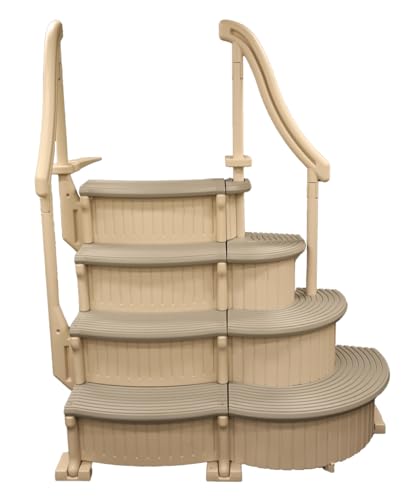
Confer Plastics Curve CCX-AG with Add-On

Superbobi BiltMor Step Replacement Platform

ROMIVO 2 Pack 50lb Pool Ladder Sandbags

FibroPool 1.5 in 3-Way Diverter Valve

FibroPool 2 in Posi-Close 3-Way Diverter Valve

Confer Plastics Step-1X Entry System (Warm Grey)
Why These Options Stand Out
If your pool ladder drifts every time a kid cannonballs, weight bags are the cheapest fix on this list. The MUSCCCM pair uses 500-denier PVC, a thick coated fabric that shrugs off splash zones and resists tearing when dragged across concrete decking.
Each bag fills to roughly 50 pounds of sand, and reinforced nylon handles make it easier to drop them into place without a funnel. For most backyards with a light resin ladder, two well-placed bags solve the floating-ladder problem in a single afternoon.
Why It Works Well
- 500D PVC holds up to repeated wetting and pool-chemical exposure
- Reinforced handles simplify carrying and repositioning
- Wide base spreads load across deck surfaces instead of digging in
- Sand-fill design avoids the cost and bulk of pre-weighted options
Things To Consider
- You supply the sand, and wet sand is heavy to haul to the pool area
- Velcro or strap closures on this style can degrade faster than the bag itself
- Not a permanent anchor, periodic re-leveling may be needed after heavy use
Who It Suits Best
Shoppers with a resin A-frame ladder that keeps creeping on a smooth concrete pad.
Where Another Pick Suits Better
Anyone who wants an integrated stair system rather than ladder ballast should look at the Confer Plastics Step-1X instead.
Drop-in steps change the feel of an above-ground pool more than almost any other upgrade, and the Confer Curve is the entry point most people consider first. Unlike the MUSCCCM weight bags that simply steady an existing ladder, this unit replaces the climb with a real staircase.
Four wide treads curve gently inward or outward depending on your deck layout, and the gray-and-beige scheme blends with most pool wall patterns. The system supports up to 400 pounds, which covers most family swimmers without flexing.
Useful Highlights
- Curved geometry gives a more natural stride than straight drop-in steps
- Reversible tread direction adapts to left- or right-side deck placement
- Two side handrails create a real grab surface for kids and older swimmers
- 400-pound capacity covers most household users comfortably
Points To Keep In Mind
- Requires sand ballast to stay seated; the unit itself does not anchor with hardware
- Tall deck installations may need the add-on extension, which is a separate purchase
- Plastic can feel cool to the touch on early-morning swims before sun hits it
Feature Snapshot
Made For
Households replacing a wobbly A-frame ladder with a permanent in-pool staircase on a standard-height pool.
Skip It When
Your deck sits high above the pool wall, since the base unit alone may leave a gap that the add-on version (Pick 3) closes.
When the deck sits a foot or more above the pool wall, the base Curve step leaves swimmers reaching for an imaginary top tread. The add-on version attaches to the same curved system, extending the staircase up to deck level so the last step lands where you’d expect.
It carries the same 400-pound rating, gray treads, and reversible geometry as Pick 2, so the upgrade does not change the look, only the reach. For most homes with raised wooden decks, this version avoids the awkward climb-down that the base unit creates.
Positive Points
- Closes the gap between pool top and elevated decks
- Maintains the same color scheme and tread style as the base step
- Same 400-pound capacity as the standalone unit
- Modular design means you can keep the base step if the deck is ever lowered
Honest Caveats
- Costs more than the base-only Curve without changing the basic climbing experience
- Still requires sand ballast for stability, no hardware anchor to the deck
- Add-on section may flex slightly on very tall decks without mid-bracing
Best Suited To
Homeowners with a raised deck who want a continuous, in-pool staircase that meets the deck cleanly.
Look Elsewhere When
You prefer a slimmer ladder-style entry instead of a full staircase, in which case pairing a standard A-frame with ROMIVO sandbags (Pick 5) is more cost-effective.
Most above-ground pool steps fail one platform at a time, and replacing the entire unit feels wasteful. The Superbobi platform is a direct-fit tread for BiltMor-style step systems, sized at 24.5 by 12 by 4 inches.
It drops into the existing frame, so a cracked or sun-bleached tread can be swapped without dismantling the staircase. Owners commonly keep a spare on hand once UV exposure starts checking the original surface.
The Helpful Details
- Matches the BiltMor footprint, no drilling or shimming required
- Non-skid surface texture mimics the original tread feel
- 350-pound capacity suits most residential swimmers
- Can be repurposed as a low garden or deck step in a pinch
Less Ideal Details
- Only fits BiltMor-compatible frames, not universal across step brands
- Color may not match a faded original exactly after several seasons of UV
- Single-tread purchase means multiple damaged steps require multiple orders
Key Product Details
Whose Shelf It Belongs On
Anyone with an aging BiltMor step system who wants to refresh the worst tread without buying a full new staircase.
Not Your Match When
You need an entirely new entry system; the Confer Plastics Step-1X (Pick 8) is the better starting point.
The ROMIVO twin pack is the practical cousin to the MUSCCCM bags, with a similar 500D PVC build but a slightly different closure approach. You get two 50-pound-capacity bags, enough ballast to anchor a standard A-frame ladder in one purchase.
Heat-sealed seams and UV-resistant material suit full-sun pool decks, where untreated fabrics can crack within a season. For most households pairing a new ladder with weighted bags, this is a tidy bundle.
Useful Strengths
- Two-bag pack covers both ladder legs in a single order
- Heat-sealed seams reduce leak risk compared to stitched alternatives
- UV-resistant shell suits exposed deck locations
- Sand-fill design lets you dial weight to the ladder, not the bag
Some Limits To Know
- Empty bags can look bulky if you only need partial fill
- Sand sourcing and transport is on you, the bags ship empty
- Closure style varies; some owners prefer a strap over a zip-top for long-term sealing
Perfect Match For
New ladder owners who want a matched ballast pair without mixing brands between legs.
Another Choice May Suit
You with a single A-frame on a perfectly flat pad may only need one bag, making the MUSCCCM single-option format (Pick 1) a slightly more efficient order.
Swapping in new steps is only half the job for many pools. The FibroPool 1.5-inch 3-way diverter valve lets you redirect water between returns, suction lines, and accessories from a single handle, which is useful when a new staircase or feature changes how flow should split.
Slip-fit connections mean standard 1.5-inch PVC pipe glues directly into the ports. The locking handle holds position under pump pressure, so you set the split once and stop fiddling.
Where It Excels
- Locking handle prevents drift under sustained pump pressure
- 3-port design supports heater bypass, water-feature feeds, and return balancing
- Standard 1.5-inch slip ports match most residential pool plumbing
- Compact body fits inside typical equipment pad layouts
Potential Drawbacks
- Not suited for 2-inch plumbing, the larger FibroPool (Pick 7) is required there
- Requires PVC primer and cement for installation, sold separately
- Not designed as a positive shutoff; pool pump must be off during valve work
Quick Facts
Right Fit For
DIYers running 1.5-inch plumbing who need to add a heater loop or feature without a full replumb.
Consider Something Else When
You need a true positive shutoff for isolation work; the FibroPool Posi-Close (Pick 7) is built for that.
The 2-inch Posi-Close steps up where Pick 6 leaves off, both in pipe diameter and in shutoff capability. The “posi-close” design gives a positive mechanical stop, so when you rotate the handle to a port, flow there is fully isolated rather than just throttled.
CPVC construction handles higher temperatures than standard PVC, which matters for heater-bypass and chlorinator bypass setups. The TEE configuration also fits cleanly into manifold layouts where multiple branches meet.
A Few Highlights
- Positive shutoff at each port simplifies service and winterization
- 2-inch slip ports match commercial-grade pool plumbing
- CPVC body tolerates elevated temperatures from heater loops
- TEE geometry works well for manifold and salt-cell bypass installs
Factors To Consider
- Oversized for smaller residential systems, may require reducer fittings
- Heavier body means sturdier mounting brackets are advisable
- Cost is meaningfully higher than the 1.5-inch version
Built With In Mind
Pool owners with 2-inch plumbing who need genuine isolation for heater or chlorator service work.
Swap It Out When
Your system runs 1.5-inch lines; the smaller FibroPool valve (Pick 6) saves money without losing core function.
Among full entry systems, the Step-1X is the no-fuss option most homeowners settle on. It fits flat-bottom above-ground pools with decks up to 60 inches high, comes in a warm gray with gray treads, and supports up to 400 pounds.
Snap-together assembly avoids loose hardware piles on the deck, and the system requires about 40 pounds of sand as ballast. It is also made in the USA, which matters to shoppers who want shorter supply chains.
The Practical Payoff
- Snap-together design cuts install time for first-time pool owners
- Mounting brackets secure the unit to most common deck heights
- Slip-resistant treads help on entry after long sun exposure
- 400-pound capacity covers most family swimmers without flex
Worth Bearing In Mind
- Manufacturer warns against combining with external weight bags, sand ballast is the intended stabilizer
- 40-pound sand fill adds setup time on install day
- Deck-height limit of 60 inches rules out very tall raised decks
Feature Rundown
Who Should Grab It
First-time pool owners with a standard flat-bottom setup who want a brand-name staircase without a complex install.
Reach For A Different Pick When
You want a curved tread style; the Confer Plastics Curve CCX-AG (Pick 2) follows a similar design language with a softer entry arc.
What Matters Most Before Choosing Above Geound Pool Steps
Match The Step To Your Deck Height
The single biggest mistake is buying a step that almost fits. Measure from the pool floor to the top of the deck, then compare against the step’s stated maximum deck height. A mismatch of even a few inches creates an awkward final climb, and very tall decks often need an add-on or a different model entirely. The Confer Curve add-on (Pick 3) exists specifically to bridge this gap for raised wooden decks.
Decide Between A Ladder And A Staircase
Ladders with weighted sandbags (Picks 1 and 5) are inexpensive and portable, but they ask more of smaller swimmers and older adults. Drop-in stair systems (Picks 2, 3, 8) cost more up front yet deliver a real handrail and flat treads. For households with kids or anyone with limited mobility, a staircase is almost always the safer long-term choice.
Confirm The Footprint Before You Commit
Drop-in steps occupy pool interior space. Curved designs swing gently inward and work well in round pools, while straight steps hug rectangular layouts. The Confer Curve (Pick 2) ships with reversible treads so you can adjust the curve direction, but the overall footprint still eats into usable swim area, something worth visualizing before install.
Plan For Repairs, Not Just Replacements
Treads crack, valves leak, and ladders rust. Choosing a brand with available replacement parts (like Superbobi for BiltMor steps, Pick 4) extends the life of your original purchase. Similarly, keeping a spare diverter valve on hand for the equipment pad cuts downtime when a fitting finally gives out.
Key Considerations Across These Picks
Pitfalls Shoppers Hit
A common error is choosing a step based on photo alone without checking the actual deck-height spec. Another is pairing a staircase with external weight bags even when the manufacturer specifies sand ballast only, which can stress the unit’s seams. For ladders, skipping the sand fill entirely turns the bags into useless lumps of fabric, so always fill to the rated capacity.
Where The Extra Money Goes
Premium drop-in steps add features you can feel on day one: thicker resin, handrails that hold under load, and treads with non-skid textures molded in rather than glued on. Made-in-USA options like the Confer Step-1X (Pick 8) often cost more because of domestic tooling and quality control. For most households, the upgrade pays off across the second and third swim seasons, when a budget model would already be cracking or fading.
Frequently Asked Questions
How do I keep my above-ground pool steps from floating?
Use weight bags filled with sand (Picks 1 or 5), or choose a drop-in step that takes sand ballast inside its base (Picks 2, 3, 8). Foam-filled or hollow steps will always try to drift unless anchored.
Can I use external weight bags with any step system?
Not always. Some drop-in stairs, including the Confer Step-1X, specifically warn against combining internal sand ballast with external weights. Check the manufacturer’s guidance before stacking ballast methods.
What deck height works with standard drop-in steps?
Most base models, like the Confer Curve (Pick 2) and Step-1X (Pick 8), fit decks up to about 60 inches. Taller installations need an add-on section (Pick 3) or a ladder-and-platform alternative.
How often should step treads be replaced?
Treads typically last 3 to 5 seasons before UV and chemical exposure degrade the surface. Replacement platforms like the Superbobi unit (Pick 4) let you swap a single worn tread without rebuilding the whole system.
Do I need a plumber to install a diverter valve?
A handy DIYer with PVC primer, cement, and a clean dry-fit can usually handle a 1.5-inch or 2-inch diverter swap in an afternoon. If the work involves the pump or heater connections, a professional is the safer call.


