

Choosing the right pump for an 8000-gallon pool shapes how the water looks, sounds, and costs to run. The right motor clears debris quickly during heavy-use weekends, while the wrong one overworks the filter or drives up your electric bill. This roundup walks through eight solid options, from compact circulation pumps to sand-filter systems that handle the full volume. If you’re sizing a new system or replacing a tired unit, the picks below cover the everyday scenarios that come up in real backyards.
A Side-By-Side Look

Aquastrong Riptide Series 3 HP Pool Pump 220V Dual Speed

Aquastrong Riptide Series 1.5 HP Pool Pump 220V Dual Speed

AQUASTRONG 18in Sand Filter Pump 1.5 HP 8100 GPH

AQUASTRONG Swimming Pool Heat Pump 7500 Gallons
Aquastrong Riptide Series 2 HP Pool Pump 220V Dual Speed
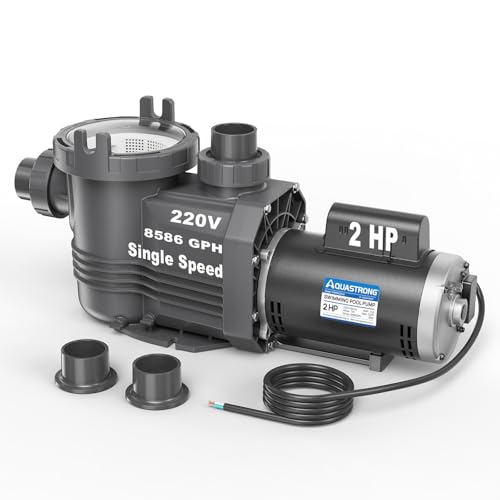
Aquastrong Riptide Series 2 HP Pool Pump 220V Single Speed

AQUASTRONG 14in Sand Filter Pump 2/3 HP 3000 GPH

AQUASTRONG 20in Sand Filter Pump 2 HP 8917 GPH
What Each Pick Brings To The Table
The 3 HP Riptide is the muscle pick on this list, built for pools that push the upper end of the 8000-gallon range or carry heavy bather loads. Dual-speed switching (two-speed pumps let you run low for everyday filtration and high for vacuuming or after storms) means the motor isn’t always running at full tilt, which keeps the noise and electric cost more reasonable than a single-speed workhorse.
You get up to 10,032 GPH on high and around 4,755 GPH on low, and the pure copper motor (copper windings tend to run cooler and last longer than aluminum alternatives) is a thoughtful detail for a pump in this class. For most backyards with standard 1.5-inch plumbing, the self-priming design and built-in filter basket make routine startup easy.
The Good Stuff
- High-speed output moves water fast, cutting turnover time on large pools.
- Dual-speed flexibility helps lower daily energy use compared to single-speed models.
- Copper motor construction is a step up in durability over aluminum windings.
- Self-priming design simplifies startup after maintenance or off-season storage.
- Integrated filter basket catches debris before it reaches the impeller.
Things To Consider
- Requires 220V wiring, so existing 115V setups will need an electrician.
- Higher initial cost than smaller HP options in the Riptide line.
Who It Suits Best
Pool owners with larger 8000-gallon+ setups who want strong flow and the option to dial back for daily circulation.
Where Another Pick Suits Better
The Aquastrong Riptide Series 1.5 HP Pool Pump 220V Dual Speed makes more sense for smaller pools where 10,032 GPH is overkill.
Stepping down to 1.5 HP, this Riptide still offers the same dual-speed architecture as the 3 HP model, just with flow rates more suited to modest pools. Up to 6,604 GPH on high and 3,302 GPH on low is plenty for an 8000-gallon above-ground setup with a sand or cartridge filter.
Compare that to the 3 HP version: you sacrifice top-end flow, but you also drop into a friendlier price bracket and reduce electrical demand. The pure copper motor, self-priming body, and debris basket are all carried over, so ownership feels familiar across the Riptide line.
Practical Advantages
- More affordable entry point into dual-speed pumping.
- Low-speed setting handles daily filtration quietly and efficiently.
- Self-priming design gets you back online fast after cleaning.
Worth Noting
- May feel underpowered for very large or heavily used pools.
- Still requires 220V wiring, which not every existing setup has.
- Flow rate tops out lower than the 2 HP and 3 HP siblings.
Made For
Smaller 8000-gallon above-ground pools and budget-focused owners who still want dual-speed savings.
Look Elsewhere When
The Aquastrong Riptide Series 3 HP Pool Pump 220V Dual Speed fits better when you need serious flow for vacuuming or high bather loads.
This is the first sand-filter combo on the list, and it shifts the question from “which pump” to “which pump-and-filter system.” The 18-inch tank handles up to 28,000 gallons of pool capacity, which covers a typical 8000-gallon pool with room to spare, and the 1.5 HP pump moves up to 8100 GPH through the system.
Where it stands apart from the bare pumps earlier in this roundup is the integrated 6-way valve (lets you switch between filter, backwash, rinse, waste, closed, and recirculate modes) and the 24-hour programmable timer with nine cycle settings. Set it once and it runs itself through daily filtration windows.
Real-World Strengths
- Bundle design eliminates the guesswork of matching a pump to a separate filter.
- Sand media catches finer particles than many cartridge filters, with longer intervals between changes.
- Programmable timer automates daily cycles and trims energy waste.
- 6-way valve simplifies backwashing (reverse flow to clean the sand) and seasonal maintenance.
Trade Offs
- Sand media requires periodic backwashing and eventual sand replacement every few seasons.
- Larger physical footprint than a pump-only unit, so plan space near the pool.
Key Specs
Right Fit For
Owners who want a complete pump-and-filter setup in one box, especially for mid-size above-ground pools.
Reach For A Different Pick When
The AQUASTRONG 14in Sand Filter Pump fits better if your pool is on the smaller end and you want a tighter footprint.
A heat pump isn’t a pump in the circulation sense, but it pairs directly with one to extend the swim season, so it earns a spot here. This Aquastrong unit heats and cools, which is a rare two-in-one at this size, and it’s rated for pools up to 7,500 gallons.
That rating sits a hair below the 8000-gallon mark, so depending on your exact pool volume and climate, you may find the heat-up time stretches on the largest pools. Heating range runs 47°F to 104°F, and cooling reaches down to 83°F, giving you shoulder-season flexibility that most heaters don’t.
A Strong Showing
- Heating and cooling in one unit, useful for year-round use.
- Wide temperature range supports spring and fall swimming.
- Heat-pump technology tends to be more efficient than gas heaters for mild climates.
Honest Caveats
- 7,500-gallon rating may leave larger 8000-gallon pools underheated in cool weather.
- Heat pumps work best in moderate climates; very cold air reduces output.
- Requires professional electrical setup in most cases.
Best Suited To
Pool owners in mild climates who want to stretch the season into spring and fall without buying separate heating and cooling gear.
Skip It When
The Aquastrong Riptide Series 2 HP Pool Pump 220V Dual Speed makes more sense if your main need is better circulation, not temperature control.
The 2 HP dual-speed sits in the middle of the Riptide family, and for many 8000-gallon pools it’s the sweet spot. Up to 8,586 GPH on high handles vacuuming and turnover without strain, while 4,427 GPH on low covers daily filtration at a quieter, thriftier pace.
You get the same pure copper motor, self-priming housing, and filter basket as the 1.5 HP and 3 HP versions, so the ownership experience is consistent. The 220V requirement is the one thing to confirm against your existing electrical panel before ordering.
What Works In Its Favor
- Middle-of-the-line flow that suits most 8000-gallon pools without overdoing it.
- Dual-speed switching keeps daily running costs manageable.
- Copper motor and self-priming design match the higher-tier Riptides.
Small Caveats
- 220V hookup is required, similar to other Riptide models.
- Not ideal for pools significantly larger than 8000 gallons.
Quick Facts
Whose Shelf It Belongs On
Standard 8000-gallon pool owners who want enough flow for vacuuming without stepping up to 3 HP.
Swap It Out When
The Aquastrong Riptide Series 2 HP Pool Pump 220V Single Speed is the right call if you prefer simpler controls over dual-speed savings.
Same 2 HP motor, same 8,586 GPH ceiling, but stripped of the dual-speed switching. That’s the trade here, and for some setups, it’s a worthwhile one. You get a simpler control panel, fewer settings to manage, and a lower entry price than the dual-speed sibling.
The catch is the energy bill: single-speed pumps run at full draw whenever they’re on, with no low-speed option for daily filtration. Owners who run short cycles or already have a variable-speed timer on the circuit may not notice much, but heavy daily users will see higher kilowatt-hour costs than with the dual-speed model.
The Value In It
- Lower upfront cost than the dual-speed 2 HP version.
- Simpler controls mean less to learn and less to troubleshoot.
- Same flow rate as the dual-speed model on high.
Points To Note
- No low-speed option means higher daily energy use.
- Less flexibility for owners who want quiet overnight filtration.
Who Should Grab It
Owners who prefer straightforward on-off operation and don’t want to manage multiple speed settings.
Consider Something Else When
The Aquastrong Riptide Series 2 HP Pool Pump 220V Dual Speed is the smarter long-term pick if you run the pump for many hours a day.
The 14-inch sand filter pump is the compact end of the lineup, sized for pools up to 13,000 gallons. For an 8000-gallon pool, that’s plenty of headroom, and the smaller tank footprint makes it easier to place beside a tight deck or in a side yard.
Up to 3000 GPH on a 2/3 HP motor is modest compared to the 18-inch and 20-inch siblings, but it still pairs with a 6-way valve and a 9-setting programmable timer, so you keep the automation features even at this size.
Well-Handled Touches
- Small footprint fits where larger sand tanks won’t.
- Programmable timer automates filtration just like the bigger units.
- 6-way valve supports backwashing and seasonal mode changes.
Less Ideal Details
- Lower flow rate means longer turnover times for 8000-gallon pools.
- Sand media still needs backwashing and eventual replacement.
Feature Card
Perfect Match For
Above-ground pool owners with limited space who still want a sand-filter system with a timer.
A Better Fit Elsewhere
The AQUASTRONG 20in Sand Filter Pump 2 HP 8917 GPH handles much larger pools and faster turnover.
The 20-inch tank closes the roundup at the high-capacity end. Rated for pools up to 38,000 gallons and pushing up to 8917 GPH through a 2 HP motor, it’s overkill for a strict 8000-gallon pool but a comfortable fit if your pool is closer to 15,000 or 20,000 gallons.
Same familiar controls as the 14-inch and 18-inch siblings, so there’s no learning curve. The 6-way valve, 9-setting timer, and sand media work together to keep maintenance predictable.
What Makes Sense
- Large tank handles pools well beyond 8000 gallons.
- Strong flow rate cuts turnover time on bigger volumes.
- Sand media traps fine particles with infrequent media changes.
- Timer and 6-way valve match the rest of the Aquastrong line.
Things To Weigh
- Bigger footprint requires more dedicated space beside the pool.
- More sand to backwash and replace than smaller tanks.
- May be more capacity than a strict 8000-gallon pool actually needs.
Key Specs
Who Will Love This
Owners of larger above-ground pools who want a sand system with extra capacity and fast turnover.
Not Your Match When
The AQUASTRONG 14in Sand Filter Pump 2/3 HP 3000 GPH fits tighter spaces and smaller pools better.
Sizing Up The Right Pump For Your Pool
Horsepower And Flow Rate
Pool pumps are rated in horsepower (HP) and flow rate in gallons per hour (GPH). HP tells you how much muscle the motor has; GPH tells you how much water actually moves through the system after factoring in plumbing resistance. An 8000-gallon pool generally wants a pump that can turn over the full volume in roughly 8 to 10 hours, which lands you in the 800 to 1000 GPH effective range after losses.
Dual-Speed Versus Single-Speed
Dual-speed pumps (a two-speed pump) let you run low for quiet daily filtration and high for vacuuming or shocking the pool. Single-speed pumps run at one rate, full stop. Dual-speed models cost more upfront, but the energy savings over a full swim season can be meaningful for daily-use pools.
Pump-Only Versus Sand Filter Combo
A bare pump pairs with whatever filter you already own. A sand filter pump bundles the pump and tank into one system, which is convenient for new installations or full replacements. If your existing filter is healthy, a pump-only upgrade makes sense. If the filter is aging too, a combo unit simplifies the swap.
Voltage And Electrical Setup
Most higher-horsepower pool pumps run on 220V, while smaller units can use 115V. Running a 220V pump on a 115V circuit will either trip breakers or simply not work. Confirming your panel setup before ordering avoids an electrician visit on delivery day.
Smart Shopping Choices For Pool Pumps
Where Shoppers Go Wrong
A common trap is buying a pump that’s oversized for the pool, assuming more flow is always better. Oversized pumps force water through the filter faster than it’s designed to handle, which actually reduces filtration quality and can cloud the water. Another frequent mistake is ignoring voltage requirements. A 220V pump in a 115V setup is a non-starter without electrical work. Finally, skipping the filter basket check leads to debris reaching the impeller (the spinning component that pushes water) and shortening motor life.
When Paying More Pays Off
Higher-tier pumps earn their keep through dual-speed switching, copper motors, and self-priming housings. The copper motor detail alone can add years of service life in hot, humid climates. Dual-speed switching is where the long-term savings compound, since most filtration hours happen at low speed. If your pump runs 8 to 12 hours a day, those quiet hours add up to real kilowatt-hour savings over a swim season.
Frequently Asked Questions
How many gallons per hour do I need for an 8000-gallon pool?
Aim for a pump that turns over the full volume in 8 to 10 hours, which works out to roughly 800 to 1000 GPH of effective flow after plumbing losses. A pump rated at 8,000 GPH will deliver far less in real-world conditions.
Are dual-speed pumps worth the extra cost?
For pools that run the pump 8 or more hours a day, dual-speed switching can pay back the price difference in energy savings over a couple of swim seasons. For shorter daily cycles, the savings are smaller and single-speed may be enough.
Can I use a 220V pump on a standard 115V outlet?
No. A 220V pump requires a dedicated 220V circuit, which usually means an electrician visit. Running it on 115V either won’t start the motor or will trip the breaker.
How often does sand filter media need to be changed?
Sand typically lasts 3 to 5 years before it loses its sharp edges and filtering ability. You’ll know it’s time when the water stays slightly hazy even after backwashing, or when channeling (paths of least resistance through the sand) becomes visible inside the tank.
What’s the difference between GPH and GPM?
GPH is gallons per hour, and GPM is gallons per minute. Divide GPH by 60 to get GPM, so 8,000 GPH equals about 133 GPM. Manufacturers often list flow in GPH, but pool pros sometimes quote GPM when sizing plumbing.
The Takeaway
The right pump for your pool comes down to volume, electrical setup, and how much daily filtration you plan to run. A 2 HP dual-speed unit like the Aquastrong Riptide hits the middle of the road for most 8000-gallon pools, while the sand filter combos give you a complete system in one box. Match the spec to your real use case, confirm the voltage, and the rest of the season takes care of itself.


