

A 20×40 pool is a big backyard investment, and the cover you choose shapes how that off-season actually feels. The right winter cover keeps leaves and debris out of the water, prevents accidental falls, and saves hours of spring cleanup. The wrong one sags into the pool, tears on the first windstorm, or simply doesn’t fit a rectangle that size.
This roundup pulls together safety covers, leaf nets, and one solar cover that all match a 20×40 footprint. Each pick works for a slightly different homeowner: some want anchor-down safety for kids and pets, others just want to stop oak leaves from staining the liner. The list below walks through nine options worth your attention, then covers the trade-offs that actually matter when you’re shopping.
A Snapshot Of The Selections

CIDNN Inground Pool Cover Safety for 20x40ft Rectangle Pools (Blue)

DEIFRE Inground Pool Safety Cover with 4x8ft Center Step Section

Buffalo Blizzard Leaf Net Cover

DEIFRE 20x40ft Inground Pool Safety Cover with Triple-Stitched Mesh

SMOPS Leaf Net Cover for 20x40ft Rectangle Pools
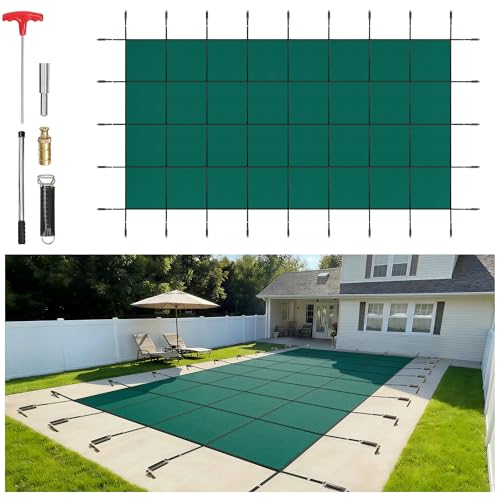
VEVOR 20×40 ft Pool Safety Cover, Green Mesh Rectangle

CIDNN Inground Pool Cover Safety for 20x40ft Rectangle Pools (Green)

BigXwell Heavy-Duty Solar Pool Cover 20x40ft, 16Mil Blue
Vecacosic 20×40 ft Pool Leaf Net Cover Rectangle
The Picks, Examined More Closely
CIDNN’s blue safety cover is the kind of straight-to-the-point option most homeowners actually want on a 20×40 rectangle. The mesh build is designed to let rainwater pass through rather than pool on top, which matters when spring thaw hits and a solid cover would otherwise turn into a wading pool. The package includes brass anchors, steel springs, and the wrenches you need, so you’re not scrambling to the hardware store on a cold Saturday morning.
Setup is genuinely approachable for a first-time cover installer, since the hardware is matched to the cover and the perimeter layout follows a standard rectangular pattern. For a family backyard with kids or pets wandering the patio, the anchor-down design gives you real peace of mind through freeze-thaw cycles. Compared to the DEIFRE option later in this list, CIDNN keeps the spec sheet simple and skips any built-in step section.
Everyday Advantages
- Mesh lets rainwater drain, cutting spring pump-out time
- Brass anchors resist corrosion across multiple winters
- Steel springs give the cover a tight, drum-like finish
- Full installation kit removes a separate shopping trip
Points To Keep In Mind
- No dedicated step section, so pools with a center step need a workaround
- Mesh covers let fine silt through over a long winter, so expect some spring vacuuming
Feature Snapshot
Best Suited To
Families with a standard 20×40 rectangle and kids or pets in the yard who want a complete, anchor-down safety cover without a separate step section.
Look Elsewhere When
You have a center step that needs separate coverage, in which case the DEIFRE Inground Pool Safety Cover with 4x8ft Center Step Section is a cleaner fit.
The standout detail on this DEIFRE cover is the integrated 4x8ft center step section, which addresses the single biggest headache with off-the-shelf safety covers. Most generic rectangles leave that step open to debris, water, and ice, which over a winter can quietly damage coping and tile. Here the step area is part of the same panel, so the seal runs continuous from one long edge to the other.
You still get the same 22×42 outer footprint for a 20×40 pool, plus the brass anchor and steel spring hardware that you’d want in any safety-rated build. If you’ve ever wrestled with a separate step cover, this integrated approach saves real time. Where it differs from the VEVOR pick later in this list is the step cutout: VEVOR sticks to a plain rectangle, while DEIFRE builds the step right in.
Where It Delivers
- Integrated step section eliminates a separate purchase and a second seal line
- 2 ft of overlap on the long edges keeps the cover snug against the deck
- Brass anchor hardware handles repeated winter removal without seizing
- Mesh build drains rain rather than forming a heavy puddle on top
Practical Considerations
- Step section is centered, so the cover only fits pools with a center step of similar size
- Measuring needs to be careful, since a misread on the step location will scrap the fit
Built With In Mind
Homeowners with a 20×40 rectangle that has a centered 4x8ft step and want one continuous cover rather than a patchwork of panels.
Reach For A Different Pick When
Your pool is a plain rectangle with no step, in which case the VEVOR 20×40 ft Pool Safety Cover gives you a simpler, less expensive fit.
Buffalo Blizzard’s leaf net isn’t a winter cover on its own, it’s a layer that goes on top of one. The 1/4 inch mesh is built to catch leaves, acorns, and twigs before they ever reach the safety cover beneath, which matters most in neighborhoods with mature oaks or maples. Rain still passes through, so the cover underneath doesn’t get crushed under standing water.
The brand builds nets for several rectangular and oval footprints in the 12×24 to 15×30 range, and the 20×40 listing targets the most common backyard rectangle. Compared to the Vecacosic net later in this list, Buffalo Blizzard uses a tighter mesh, which catches smaller debris but also means more frequent removal before the weight adds up. In most leaf-heavy yards, that’s a worthwhile trade.
Advantages To Know
- Tight 1/4 inch mesh stops acorns and small twigs, not just leaves
- Breathable build prevents rain buildup on top of the winter cover
- Rot-resistant webbing survives multiple fall seasons in damp piles
Worth Bearing In Mind
- You’ll still need a real winter safety cover underneath, since the net alone won’t anchor the pool
- Heavier leaf loads mean periodic removal so the net doesn’t stretch or tear under the weight
The Right Fit
Homeowners in heavy leaf-drop areas who already have a safety cover and want a sacrificial layer that keeps the main cover clean.
Consider Something Else When
You need the primary winter cover itself, not a debris layer, in which case the CIDNN blue safety cover does the anchoring job.
This DEIFRE entry focuses on the parts that take the most punishment: the stitching and the mesh. The high-strength PP (polypropylene) mesh is built for the kind of repeated wet-and-dry, freeze-and-thaw abuse a long winter dishes out, and the triple-stitched seams address the most common failure point on budget covers. Where the CIDNN pick earlier is more about value, this one is about the build.
For a 20×40 pool you get the same 22×42 ft outer dimension with 2 ft of extra coverage for tight edge sealing, which closes off the gap that wind-driven rain would otherwise exploit. The kit ships with brass anchors, steel springs, and an Allen wrench. In our view, this is the right pick for exposed yards where wind loading is the bigger concern.
Key Advantages
- PP mesh resists UV breakdown through multiple seasons of sun exposure
- Triple-stitched seams handle snow load better than single-stitched builds
- 2 ft overlap on each side reduces edge gaps that let wind-driven water through
- Brass anchor hardware arrives ready to install
Trade-Offs To Consider
- Heavier fabric takes a little more effort to spread and align during install
- PP mesh costs more than entry-level covers, so the upfront spend climbs
Made For
Backyards with strong winter wind exposure or heavy snow load where seam failure is the bigger risk than price.
Where A Sibling Pick Shines
You want a softer entry-level cover for a sheltered yard, in which case the CIDNN blue safety cover is easier on the budget and the install.
SMOPS leans into the messy part of pool ownership: leaves, twigs, and the slow staining they leave on a winter cover. This mesh net spreads over your existing safety cover and acts as a debris shield, so when you pull it off in spring, the cover underneath is still clean. The 20×40 sizing is explicit on the listing, which removes a lot of guesswork for rectangular pools.
Where it differs from the Buffalo Blizzard net is the broader size range. SMOPS offers multiple rectangular and oval footprints, including smaller 12×20 and 12×24 listings, which is helpful if your pool setup is unusual. The mesh is the same general idea, though, so the trade-offs around heavy leaf loads and periodic removal are similar.
Strong Points
- Listed specifically for 20×40 rectangles, removing sizing guesswork
- Wide size range covers both standard and irregular pool shapes
- Breathable mesh lets rain pass through to the cover below
Worth Noting
- Net alone won’t anchor the pool, so a real safety cover stays required
- Best results come from removing accumulated leaves before the weight gets serious
Who It Suits Best
Homeowners with an existing safety cover who want a debris layer sized precisely for a 20×40 rectangle.
Skip It When
You need a primary anchor-down cover rather than a debris shield, in which case the DEIFRE 20x40ft Inground Pool Safety Cover does the structural job.
VEVOR’s green mesh cover targets a standard 20×40 rectangle without any bells or whistles, which is often exactly what you want. The 22×42 ft outer dimension leaves about 1 ft of overlap per side, a touch tighter than the 2 ft overlap on the CIDNN and DEIFRE covers, but still enough to anchor cleanly along a standard deck. The green color blends into a lawn better than blue, which is a small but real consideration for landscape-conscious yards.
The build uses a heavy-duty PP mesh that’s been VEVOR’s main safety-cover material for a while, and the brand lists the cover for residential, hotel, and garden pool use. If you’ve been on the fence between this and the CIDNN option, the honest read is that the VEVOR trades a bit of overlap for a cleaner color match. Both covers ship with the same general hardware approach.
Strengths Worth Knowing
- Green mesh fades into lawn scenery better than blue alternatives
- PP mesh is built for repeated wet-dry cycles without falling apart
- Suits residential, hotel, and garden pool installations
- Standard rectangular shape simplifies first-time installation
Honest Caveats
- 1 ft of overlap is slightly less than some competitors, so a precise deck edge helps
- No step section, so pools with a centered step need a separate panel
Perfect Match For
Homeowners with a plain 20×40 rectangle who prefer a green cover for visual reasons and don’t need a step section.
A Better Fit Elsewhere
You have a step that needs coverage, in which case the DEIFRE Inground Pool Safety Cover with 4x8ft Center Step Section handles that geometry out of the box.
The green CIDNN cover is essentially the same build as the blue version earlier in this list, with a different color that better matches a lawn-heavy backyard. You still get the 22×42 outer footprint, the 2 ft overlap, the brass anchors and steel springs, and the full installation kit. For homeowners who prefer their pool cover to recede rather than stand out, that color swap is the whole reason to pick this one over its blue sibling.
The mesh build keeps rainwater draining, which matters just as much here as on the blue cover, since standing water is what eventually sags a cover into the pool. Compared to the VEVOR green cover, the CIDNN has slightly more overlap per side, so if your deck has irregular coping the extra margin helps. Where it differs from the DEIFRE option is the simpler rectangle, with no step section included.
What Pays Off
- Green color blends into lawn scenery through winter
- 2 ft overlap on each side handles slightly irregular deck edges
- Brass anchors and steel springs arrive in the same box
- Mesh fabric drains rain without pooling
Softer Spots
- No step section, so pools with a centered step still need a workaround
- Color choice is the main differentiator, so if green doesn’t matter to you the blue version is the same cover
Feature Snapshot
Right Fit For
Homeowners with a standard 20×40 rectangle who want the same CIDNN build as the blue cover but prefer green to match a lawn-heavy yard.
Not Your Match When
You need a step section, in which case the DEIFRE Inground Pool Safety Cover with 4x8ft Center Step Section does the job with one panel.
The BigXwell 16 mil solar cover sits in a different category from the rest of this list. It’s not a safety cover, and it’s not designed to anchor down a pool for the winter. What it does is float on the surface, trap heat from sunlight, and slow evaporation, which is exactly the right tool for a 20×40 pool in a mild-winter climate where you’re still swimming into late fall and starting again in early spring.
The 16 mil thickness is on the heavier end of solar covers, which means it handles the repeated reel-on, reel-off cycle without tearing at the fold lines. Compared to the safety covers earlier, this is a different decision entirely: you’re not trying to seal the pool, you’re trying to keep it warm. For the right climate, that trade is worth it.
Where It Excels
- 16 mil thickness holds up to repeated reel use without tearing
- Traps solar heat, cutting heater runtime during shoulder seasons
- Reduces water and chemical loss from evaporation
- 20×40 ft fits a standard residential rectangle
Trade-Offs To Consider
- Not a safety cover, so it won’t anchor the pool or block accidental falls
- Less useful in regions with hard freezes, where a true winter cover is the right tool
Who Should Grab It
Homeowners in mild-winter climates who want to extend the swimming season and cut evaporation, not seal the pool for months.
Where A Sibling Pick Shines
You live somewhere with real winter weather and need a true safety cover, in which case the CIDNN blue cover does the actual sealing job.
Vecacosic’s leaf net takes a generous approach to coverage. The 44×24 ft footprint gives the net plenty of overhang to drape well past the edge of a 20×40 cover, which means leaves that land on the deck have a longer path before they reach the pool. Like the Buffalo Blizzard and SMOPS nets earlier, this is a layer that goes on top of your real winter cover.
The build is meant to handle leaves, branches, debris, and insects, which keeps the pump and filter from getting hammered by organic matter in the spring. Compared to tighter-mesh options, the slightly more open weave trades fine-debris filtering for breathability, so the cover below doesn’t get moisture-trapped. Depending on your leaf type, that trade can go either way.
Notable Gains
- Generous 44×24 ft footprint covers a 20×40 cover with overhang to spare
- Helps prevent filter blockages and reduces pump strain in spring
- Breathable build avoids moisture buildup on the cover below
Factors To Consider
- Net alone is not a safety cover, so a separate anchor-down cover stays required
- Looser weave catches bigger debris but lets some fine matter through
Built With In Mind
Homeowners with a 20×40 pool who deal with large leaf and branch debris and want a wide-coverage shield over the main cover.
Swap It Out When
You need a primary cover, not a debris layer, in which case the CIDNN blue safety cover handles anchoring and sealing in one piece.
What Matters Most Before Choosing a 20×40 Winter Pool Cover
A winter pool cover is a long-term purchase, and the wrong one shows up as a spring full of murky water, damaged coping, or a torn cover. The factors below are the ones that actually shape how a 20×40 cover performs through a real winter, not just how it looks on a listing.
Measure Twice, Buy Once. A 20×40 pool is the most common size in the category, but the cover you need is usually 22×42 to give 2 ft of overlap per side. Measure length, width, and any step section before ordering, and double-check whether the cover assumes a centered step or a plain rectangle. A misread here means returning the cover before you ever install it.
Mesh Versus Solid. Mesh covers let rainwater drain through, so they don’t form a heavy pond on top, but they let fine silt settle into the pool. Solid covers block everything but hold standing water, which means a pump or cover pillow is needed. Most homeowners with a 20×40 rectangle lean toward mesh for the easier spring cleanup.
Safety Coverage Matters. A true safety cover is anchored down with brass anchors and steel springs, and it can support the weight of a child or pet that wanders across it. A leaf net or solar cover does not offer that protection. If kids, pets, or neighborhood foot traffic are part of the picture, an anchor-down safety cover is the responsible choice.
Hardware Quality Drives Longevity. Brass anchors resist corrosion across multiple winters, while steel springs keep tension consistent. Plastic hardware tends to become brittle in the cold and is the most common failure point. Looking at the included hardware list, not just the fabric, is the easiest way to predict how a cover will age.
Key Considerations Across These Picks
Pitfalls Shoppers Hit
The most common mistake in this category is trusting the pool size label without checking the cover’s actual dimensions. A 20×40 pool almost always needs a 22×42 cover for proper overlap, and listings that say “fits 20×40” can mean either the pool or the cover. Read the fine-print dimensions, not just the title.
Another slip is treating a leaf net as a primary cover. Nets are sacrificial layers that sit on top of a real safety cover, and they don’t anchor the pool or block accidental falls. For winter-long sealing, only an anchor-down safety cover does that job.
Where The Extra Money Goes
Higher-tier covers in this category spend the premium on the materials that age slowest: PP mesh instead of basic woven fabric, brass instead of plated steel, and triple-stitched seams at the stress points. The result is a cover that handles multiple winters without the seam failures that plague budget picks.
For mild-winter climates where the cover isn’t loaded with snow for months, the upgrade matters less, and a value cover is a reasonable pick. For windy, snow-heavy, or leaf-heavy regions, the heavier build pays for itself by avoiding one mid-winter replacement.
Frequently Asked Questions
What size cover do I need for a 20×40 pool? A 20×40 inground pool typically needs a 22×42 safety cover, which gives 1 to 2 ft of overlap on each side for clean anchoring. Always measure the actual pool deck, not just the water, since the cover anchors to the deck surface.
Do I need a leaf net on top of my winter cover? A leaf net is optional but useful in heavy leaf-drop areas. It catches debris before it reaches the cover below, which keeps the main cover cleaner and reduces spring pump-out time. It’s not a substitute for the safety cover itself.
Can a 20×40 cover handle snow and ice? Yes, when the cover is a true safety-rated mesh with brass anchors and steel springs. The mesh lets water drain so ice doesn’t pool on top, and the anchor system handles the weight of moderate snow. Solid covers need a pump to remove standing water.
How long does a 20×40 winter pool cover last? A quality mesh safety cover typically lasts 8 to 12 years, depending on sun exposure, snow load, and how carefully it’s removed each spring. Budget covers often show seam wear in 3 to 5 years. Storing the cover clean and dry in the off-season extends its life.
Is a 16 mil solar cover enough for winter? No, a solar cover is designed to float on the surface and trap heat, not to seal the pool for winter. In mild climates it’s useful for extending the swim season, but in regions with freezing temperatures a true anchored safety cover is the right tool.
Final Verdict
A 20×40 pool gives you nine solid options to choose from, and the right pick depends on what kind of winter you’re closing the pool against. For most homeowners with kids or pets in the yard, an anchor-down safety cover like the CIDNN blue or DEIFRE triple-stitched mesh is the responsible baseline, while leaf nets like the Buffalo Blizzard or Vecacosic add a debris layer in heavy leaf-drop areas. The BigXwell solar cover stands apart as the right call for mild-winter climates where the goal is heat retention, not full sealing. Match the cover to your climate, your debris load, and your step geometry, and the rest of the winter pretty much takes care of itself.


