

Keeping a backyard pool clear and sanitary takes more than a single product. Between weekends of heavy use, surprise rainstorms, and a long summer ahead, a granular or liquid chlorinator becomes the workhorse that keeps water in shape. The five options below all center on stabilized chlorine and calcium-free chemistry, so they suit salt systems and liquid-chlorine pools without piling on mineral buildup. The goal here is a straightforward comparison: match each format to the right pool size and maintenance routine, and skip the trial-and-error.
Your Options, Compared
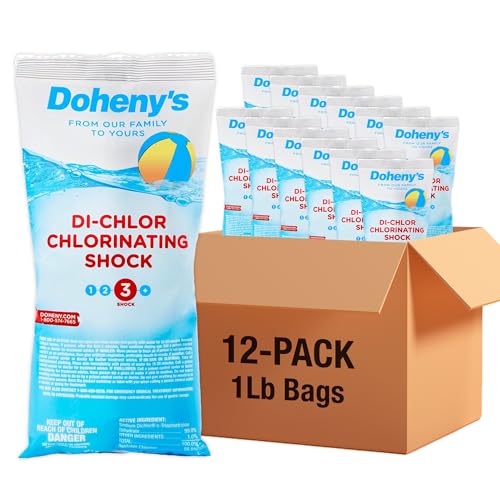
Doheny’s Di-Chlor Shock 12 x 1lb Bags (12lb)

Doheny’s Di-Chlor Shock 6 x 1lb Bags (6lb)

Doheny’s Di-Chlor Shock 24 x 1lb Bags (24lb)

Doheny’s Di-Chlor Granular Chlorine 50lb Bucket

Doheny’s Di-Chlor Granular Chlorine 5 lb.
A Breakdown Of The Leading Choices
The 12-bag case lands in that middle ground where most backyard pool owners actually live. A dozen individually wrapped 1-pound pouches of stabilized granular chlorine (sodium dichlor, a fast-dissolving chlorine compound that resists UV breakdown) covers a normal 20,000-gallon pool for the better part of a swim season, with extra on hand for post-storm shocks or algae touch-ups. The calcium-free formula plays nicely with both saltwater chlorine generators and traditional liquid chlorine setups, which matters in regions where hard fill water already pushes total hardness upward.
Splitting the supply into single-pound bags keeps handling simple: tear, pour, broadcast, and reseal. The trade-off is more plastic waste per pound than a bulk tub, but it also means less exposure to moisture between treatments. For households shocking weekly through summer, this format usually disappears before it can clump.
Good Reasons To Consider
- Mid-size case fits a typical family pool’s seasonal use without overbuying
- Granular format dissolves quickly, shortening the wait before swimming resumes
- Calcium-free formula suits saltwater generators and liquid chlorine programs
- Individual pouches reduce moisture exposure and the risk of caking in storage
Worth Noting
- More individual pouches to handle than a single 50-pound bucket, depending on how often the pool is shocked
- Granular chlorine must be pre-dissolved in a bucket of pool water for vinyl liners, according to standard handling guidance
At A Glance
Who It Suits Best
Pool owners with a typical 15,000 to 25,000-gallon backyard pool who shock on a regular weekly schedule through the swim season.
Consider Something Else When
Service pros maintaining multiple large pools will get better per-pound value and less packaging waste from the Doheny’s Di-Chlor Granular Chlorine 50lb Bucket.
Six 1-pound pouches is a low-commitment way to try stabilized granular chlorine before committing to a season’s worth. For a smaller above-ground pool, a hot tub, or a first-time pool owner still learning the rhythm of weekly testing and shocking, this is a useful starting size. It shares the same calcium-free, fast-dissolving sodium dichlor chemistry as the larger Doheny’s cases, so the learning curve transfers cleanly if the household scales up later.
The 1-pound dose lines up neatly with the standard 1 pound per 10,000 gallons recommendation, so new owners can follow the label without wrestling with kitchen scales. Anyone with a 10,000-gallon or smaller pool will get roughly six treatments out of one case, which covers most of an early summer or a strong opening-week shock cycle.
Points In Its Favor
- Small case size lowers the entry cost for first-time pool owners
- Each pouch matches the typical 1 lb per 10,000 gallons guideline exactly
- Same calcium-free dichlor formula as the larger 12-bag and 24-bag options
Trade Offs
- Higher cost per pound than the 12-bag or 24-bag cases for the same chemistry
- Limited supply for pools over 15,000 gallons that shock more than once a month
- Granular form requires pre-dissolving in a bucket for vinyl liner pools, as with other dichlor shocks
Made For
First-time pool owners with small or medium above-ground pools who want to learn the shocking routine without buying more than they need.
Look Elsewhere When
Pool owners ready to stock a full season’s worth of supply in one purchase should move to the Doheny’s Di-Chlor Shock 12 x 1lb Bags case for better value and longer coverage.
The 24-bag case is the same formula as the 6- and 12-bag pouches, just in a deeper bench. For larger in-ground pools, rental properties, or households that shock more than once a week during peak summer, this is the format that keeps a service closet stocked through the season. Twenty-four pounds of stabilized dichlor covers multiple treatments of a 25,000-gallon pool, with reserve capacity for surprise algae blooms after heavy rain or a backyard party.
Handling-wise, the case is bulky and the individual pouches add up to more plastic to dispose of than a single bucket. The upside is the same single-dose convenience: no scoop, no scale, no clumping. For service routes that visit several pools each week, the format also makes it easy to grab a known quantity per stop.
Practical Advantages
- Bulk case size suits larger in-ground pools, rentals, and service routes
- Single-pound pouches keep dosing simple and consistent across multiple treatments
- Calcium-free dichlor supports saltwater and liquid chlorine programs equally well
Points To Keep In Mind
- Bulky case takes up more storage space than a single 50-lb bucket or a smaller case
- Highest plastic-to-product ratio of the lineup, which matters for households trying to cut waste
Best Suited To
Owners of larger in-ground pools or pool service pros handling several accounts who want a season’s worth of granular shock in one shipment.
Swap It Out When
Single-pool households looking to minimize packaging should consider the Doheny’s Di-Chlor Granular Chlorine 50lb Bucket, which delivers the same chemistry in a reusable container.
For owners who want a single container doing triple duty, the 50-pound bucket leans into the 3-in-1 framing. Marketed as a sanitizer, shock, and algaecide in one, it carries 99.5% sodium dichlor and 56% stabilized available chlorine (the percentage of chlorine in the product that is actually available to sanitize the water), all calcium-free. The bucket format also cuts down on the plastic waste of pouched versions, since the same pail can be resealed between uses.
Service techs and owners of large residential pools are the natural fit. Anyone with a 25,000-gallon-plus pool or a route of several properties will appreciate the lower per-pound cost and the storage-friendly container. Smaller pools, however, may struggle to get through 50 pounds before the season turns, which raises storage and freshness concerns in humid garages.
Useful Strengths
- Bulk 50-pound pail delivers the lowest per-pound cost in the lineup
- 3-in-1 formula aims to handle sanitizing, shocking, and algae control from one container
- Reusable pail reduces single-use plastic compared to pouched alternatives
- Calcium-free and 99.5% sodium dichlor purity suit both saltwater and liquid chlorine pools
Honest Caveats
- Fifty pounds is overkill for small above-ground pools and may sit through multiple seasons
- Open-bucket storage requires a dry, sealed environment to prevent clumping from humidity
- Heavier to handle and pour than single-pound pouches, especially for one-person use
Feature Snapshot
Whose Shelf It Belongs On
Pool service professionals, vacation rental owners, and households with large in-ground pools who can put 50 pounds to work before the season ends.
Reach For A Different Pick When
Owners of small backyard pools who only shock a handful of times per season will find the Doheny’s Di-Chlor Granular Chlorine 5 lb jar a more manageable size.
The 5-pound jar shares the 3-in-1 framing of its 50-pound sibling in a much friendlier package. For small above-ground pools, spas, or anyone who only needs to shock a few times per season, this format keeps the chemistry accessible without the bulk. The same 56% stabilized available chlorine means dosing is consistent with the larger options, so an owner can scale up later without learning a new product.
Storage is the easy win: 5 pounds fits on a garage shelf next to the test kit, and the small footprint means even humid environments are less of a concern. For anyone testing the waters with dichlor for the first time, this is a lower-risk way to find out how the chemistry behaves in their pool before committing to a 12- or 24-bag case.
A Strong Showing
- Compact 5-pound jar fits easily on a shelf next to a test kit or in a small storage closet
- Same 3-in-1 dichlor profile as the larger 50-pound bucket, in a manageable size
- Lower commitment for households that shock only a handful of times per year
Small Caveats
- Higher cost per pound than any of the pouched or bucketed bulk options in the lineup
- Limited supply for pools above 10,000 gallons that need frequent shocking
Perfect Match For
Small-pool owners, spa users, and first-time buyers who want a low-commitment introduction to stabilized dichlor before scaling up.
Where Another Pick Suits Better
Households with mid-size in-ground pools ready to stock a season’s supply will get better value from the Doheny’s Di-Chlor Shock 12 x 1lb Bags case.
What To Weigh Before Choosing A Pool Shock
Choosing a chlorinator starts with the pool, not the product. Match the format to the gallons, the bather load, and the existing equipment before worrying about brand or container size.
Active Chemistry And Stabilizer Content
Stabilized chlorine, in the form of sodium dichlor (often abbreviated as Di-Chlor), pairs cyanuric acid (a UV-protecting conditioner that prevents sunlight from burning off chlorine) with the active chlorine molecule. That stabilizer is the difference between pouring chlorine into a sunny pool and watching it vanish in hours. For outdoor pools especially, dichlor’s built-in protection keeps residual chlorine working longer between doses. The trade-off is that cyanuric acid accumulates over time, so weekly testing matters: above roughly 100 ppm, stabilizer can start to lock up the chlorine and force a partial drain.
Calcium-Free Matters In Hard-Water Regions
Most pool shock products add calcium hardness as a side effect, which is fine for plaster pools in soft-water regions but a problem for vinyl liners and saltwater systems. A calcium-free dichlor keeps total hardness stable and avoids the cloudy water and scale deposits that come from months of buildup. Households already running a salt cell or supplementing with liquid chlorine will appreciate a formula that doesn’t double up on what their equipment is already producing.
Format, Dosage, And Storage Reality
Granular shock, the format these five options all use, dissolves quickly and gives precise control over the dose. The trade-off is that it must be pre-dissolved in a bucket of pool water before adding to vinyl-liner pools, per standard handling guidance. Pouches are tidy but generate more plastic waste, while buckets are efficient in bulk but heavy and sensitive to humidity once opened. Match the size to how much chlorine the pool actually consumes: a 10,000-gallon pool shocking weekly needs roughly 4 to 5 pounds per month in summer, while a 25,000-gallon pool with heavy use can chew through three times that.
Routine Compatibility With Saltwater And Liquid Chlorine
These dichlor options play well alongside saltwater chlorine generators and traditional liquid chlorine programs. The catch is that running dichlor and a salt cell at the same time can push cyanuric acid levels upward faster than expected, since both contribute stabilizer. Weekly test-strip readings of cyanuric acid help avoid the slow climb into “chlorine lock” territory, where the chlorine is technically present but no longer effective.
Key Considerations Across These Picks
Pitfalls Shoppers Hit
A common mistake is buying a 50-pound bucket to “save money” without checking whether the pool will actually use that volume before the next season. Dichlor keeps well in a sealed pail, but humidity and repeated openings shorten its shelf life, and clumped granules are tougher to dose accurately. Another trap is assuming that “stabilized” means chlorine stays effective forever: cyanuric acid still accumulates, and over-stabilized pools can harbor algae even with chlorine levels reading normally on a test strip.
Where The Extra Money Goes
Larger pouched cases and the 50-pound bucket cost more up front but drop the per-pound price noticeably, and a resealable pail cuts down on single-use plastic. The smaller 5-pound jar and 6-bag case cost more per pound but spare the household the storage headache and the risk of chlorine going stale before it’s used. For most pool owners, the sweet spot is the mid-size 12-bag case: enough supply to cover a season without the bulk of a 50-pound pail.
Frequently Asked Questions
What does “stabilized chlorine” actually mean?
Stabilized chlorine contains cyanuric acid, which acts as a sunscreen for the chlorine molecule and slows the rate at which UV light burns it off. In outdoor pools, this means longer-lasting residual chlorine between treatments. The trade-off is that cyanuric acid levels can build up over time and may require a partial drain if they climb too high.
How much dichlor shock should be used per 10,000 gallons?
The standard guideline is 1 pound of granular dichlor per 10,000 gallons of pool water for a regular shock treatment. Heavier algae situations or post-storm recoveries may call for double or triple doses, applied gradually rather than all at once, until the water clears and chlorine levels hold steady.
Can dichlor shock be used in a saltwater pool?
Yes, dichlor works in saltwater pools as a supplemental shock alongside the salt chlorine generator. The two systems can coexist, but the cyanuric acid from dichlor will accumulate over time, so weekly testing helps prevent over-stabilization, a state where chlorine becomes less effective because too much stabilizer is present.
Is dichlor safe for vinyl liner pools?
Dichlor is safe for vinyl liners, but standard handling guidance is to pre-dissolve the granules in a clean bucket of pool water before pouring the solution into the pool. Broadcasting dry granules directly onto a vinyl surface can cause bleaching or surface damage.
How should granular chlorine be stored between uses?
Granular dichlor should be kept in its original sealed container, stored in a cool, dry, well-ventilated space away from direct sunlight and incompatible chemicals. Moisture and heat shorten the product’s effective life and can lead to clumping, which makes accurate dosing harder.
Wrap Up
The right format depends on pool size, shock frequency, and storage comfort. A 5-pound jar or 6-bag case fits a casual routine, while a 12- or 24-bag case covers most residential seasons. Service pros and large-pool owners get the best per-pound value from the 50-pound pail. Any of these five will keep a saltwater or liquid chlorine pool clear, as long as cyanuric acid is watched and the dose matches the gallons.


