

Salt chlorine generators keep pool water soft on the skin and easy on the eyes, yet they only run smoothly when salt concentration sits inside a narrow band. Too low and the cell stops producing chlorine; too high and corrosion creeps into metal fittings. A reliable tester turns guesswork into a quick dip or a digital reading, so this roundup focuses on tools that make that step painless. The picks range from simple dip strips you can toss in a caddy to compact digital meters that also track pH and chlorine. Whatever the pool size or the level of curiosity, the goal is the same: spend less time second-guessing and more time swimming.
A Fast Comparison Of The Options

Fluke 117 Digital Multimeter with Non-Contact Voltage Detection

Fluke 323 Clamp Meter for AC Current and Voltage

Fluke 1AC II VoltAlert Non-Contact Voltage Tester

AquaChek Salt Test Strip Titrators for Pools (10 Strips)

AquaChek Salt Titrators White (561161)
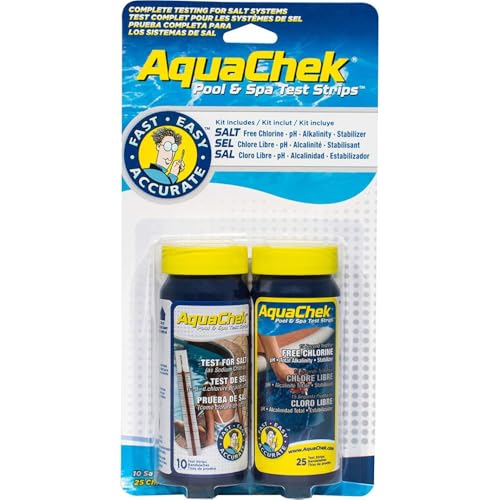
AquaChek Salt System Test Kit for Pools and Spas

EASYTEST Saltwater Pool Test Strips 0-8000 ppm, 25 Count

Digital Chlorine Tester Pool Salinity Meter

pH Meter Chlorine Tester Digital 7-in-1 Pool Water Tester Kit
Taking A Closer Look At The Options
The Fluke 117 earns its place here because it does far more than spot a live wire. In a pool equipment pad, you often need to confirm that a salt cell is actually drawing current, that a bonding wire is intact, and that no stray AC voltage is creeping into the water. A digital multimeter (a meter that measures volts, amps, ohms, and more) with true RMS (root mean square, which gives accurate readings on the irregular waveforms produced by modern electronics) handles that workload confidently.
For most homeowners running a single salt system, the 117 may be more instrument than required. For a service tech or a serious DIYer, the non-contact voltage detection, Min/Max/Average capture, and frequency and capacitance readings turn it into a one-meter toolkit. Compared to the Fluke 1AC II VoltAlert reviewed below, the 117 reads actual numbers instead of chirping at the presence of voltage.
Well-Handled Touches
- True RMS readings stay accurate on the noisy loads produced by variable-speed pool pumps.
- Non-contact VoltAlert sensing lets you check for live conductors before touching anything.
- Low-impedance mode helps prevent false positives from ghost voltage on long runs of wire.
- Large white LED backlight makes readings legible in a dim equipment pad.
Small Caveats
- The feature set is overkill for someone who only wants to dip a salt strip.
- Probes and leads tend to be the first accessories replaced after years of outdoor work.
At A Glance
Whose Truck It Belongs On
Pool service technicians, electricians, and hands-on homeowners who already test voltage and current as part of their routine.
Reach For A Different Pick When
The AquaChek Salt Test Strip Titrators are a better match for owners who just want a quick salinity reading and no electrical work.
The Fluke 323 is a clamp meter (a tool that measures current by clamping around a wire rather than breaking the circuit), so it slips around a conductor without you ever disconnecting a wire. On a salt cell, that means a quick check that the unit is pulling the right amperage without any of the shutdown-and-strip work a traditional multimeter demands. It also reads AC and DC voltage up to 600 V and resistance to 4 kilohms.
For most homeowners, this is more tool than pool care requires. For an electrician verifying a bonding loop or a tech commissioning a new salt system, the soft carrying case and true RMS sensing make daily use feel routine. The Fluke 117 above covers more electrical variables on a numeric display; the 323 wins on speed for current checks.
Advantages To Know
- Clamp jaw reads up to 400 A of AC current without breaking the circuit.
- True RMS sensing keeps readings honest on modern variable-speed pump loads.
- Soft carrying case and included warranty make transport to job sites simple.
- Compact jaw fits inside crowded pool subpanel enclosures.
Honest Caveats
- Does not measure DC current, which limits use on some low-voltage DC pool components.
- Resistance ceiling of 4 kilohms is modest for specialty diagnostics.
- Probes and clamp jaw both need occasional cleaning to prevent slipping in humid conditions.
Built With In Mind
Licensed electricians and pool service pros who need to verify salt cell draw without shutting anything down.
Look Elsewhere When
Casual owners should grab the EASYTEST Saltwater Pool Test Strips instead and leave the clamp work to a pro.
The Fluke 1AC II is a pocket-friendly pen that beeps and glows red at the tip when AC voltage is present, no metal-to-metal contact required. The CAT IV safety rating (a category that certifies the tool for use near main service panels and outdoor feeders) means it is rated for the kind of outdoor feeders and pool subpanels you will actually touch. Detection runs from 90 V to 1000 V AC, which covers virtually anything around a residential pad.
For most pool owners, the honest read is that this is a safety accessory more than a salt tester. It does not measure salt or read numerical values; it answers the simpler question, “is this wire live?” Owners who already own the Fluke 117 above will not need both, but for anyone working around a pump or salt cell for the first time, a 30 dollar pen is cheap insurance.
Everyday Advantages
- Pen-style form slides into a shirt pocket between jobs.
- Audible beeper and glowing tip give clear go/no-go feedback.
- Continuous self-test confirms the tool is working before each use.
- CAT IV rating supports safe work near pool service equipment.
Things To Weigh
- It indicates presence of voltage only; no numeric readout is provided.
- Battery life is reasonable but the cells live behind a captive door that can wear with frequent swaps.
Right Fit For
Anyone opening a pool equipment panel for the first time and wanting a quick live-wire check before touching a terminal.
Not Your Match When
You actually need to measure salt concentration; the AquaChek Salt Titrators White 561161 below do that job directly.
Now we get to the actual salt testers. The AquaChek Salt Test Strip Titrators are white strips that you dip into pool water, swirl, and compare to a printed color block. Salt concentration in a saltwater pool typically needs to sit between roughly 2,700 and 3,400 ppm (parts per million) for a salt chlorine generator to run happily, and these strips cover a generous 400 to 7,000 ppm range, so they work for both swimming pools and spas.
The workflow is simple enough that almost anyone can run a check. The trade-off is human interpretation: lighting and the angle of comparison can nudge a reading a couple hundred ppm either way, depending on your eyes. Compared to the 40-strip AquaChek bottle below, this 10-strip pack is more of a trial size or a travel pack than a season’s worth of tests.
Benefits That Matter
- Wide 400-7,000 ppm range covers both pool and spa salt systems.
- No reagents, no counting drops, and no calibration step required.
- Small pack fits in a pool-side caddy for quick weekly dips.
Practical Considerations
- Color matching is subjective, so two readers can land on different numbers in poor light.
- Ten strips run out fast for a household testing every week through summer.
Best Suited To
New pool owners wanting a low-fuss way to learn their baseline salt reading before committing to a larger bottle.
Skip It When
You would rather test weekly without reordering every two months; the 40-strip AquaChek Salt Titrators White 561161 is the better economy pick.
Same strip chemistry, bigger bottle. The 561161 version of the AquaChek Salt Titrators ships 40 strips in a single bottle, which covers an entire swim season for most households. Hach chemistry backs the pad, so the readings hold up against liquid test kits commonly used at pool stores.
For a typical residential pool checked once a week, the 40-strip bottle typically lasts from Memorial Day through Labor Day, depending on your routine. Compared to the 10-strip pack above, the per-test cost drops noticeably. The trade-off shows up if you are testing a spa, where the wide 400 to 7,000 ppm range is plenty and 40 strips may sit in the bottle longer than you would like.
Notable Upsides
- Forty strips in one bottle keep cost-per-test low for the whole season.
- Color chart printed on the bottle means one less thing to misplace.
- Results appear in just a couple of minutes, so it fits a Saturday morning routine.
Where It May Fall Short
- Same human-eye interpretation limits as other colorimetric strips.
- Bottle needs a cool, dry storage spot to keep pads from degrading between uses.
Made For
Residential pool owners who test weekly and want one bottle to span the season without reordering.
Another Choice May Suit
Households tracking salt along with pH and chlorine should step up to the AquaChek Salt System Test Kit for a combo approach.
Salt is only one piece of pool chemistry, and the AquaChek Salt System Test Kit bundles the white salt strips with a yellow 4-way strip that covers free chlorine, combined chlorine, pH, and total alkalinity. The kit lands 25 of each strip type, which keeps both routines running on the same schedule.
For a backyard pool or spa, the convenience of a single box outweighs the small premium over buying two bottles separately. The 4-way strips also include a cyanuric acid (CYA) pad, which is the stabilizer that protects chlorine from sunlight, and skipping that one is a common reason saltwater systems seem to “burn through” chlorine in midsummer. Compared to the digital meters reviewed below, this kit is slower per test but easier to share with family members.
Everyday Perks
- One box covers salt, pH, chlorine, alkalinity, and CYA.
- Matching strip counts keep both routines on the same refill cycle.
- No batteries or calibration to worry about.
Potential Compromises
- Color interpretation still depends on lighting and the viewer’s eye.
- Pad exposure to humidity can shorten shelf life if the cap is not closed tightly.
Who It Suits Best
Pool and spa households that want one kit for the full weekly routine, not a separate bottle for each parameter.
Swap It Out When
You would rather read a digital number than compare colors; the GIDIGI 7-in-1 digital meter handles several parameters without color matching.
EASYTEST covers a wider range than most pool salt strips, with a 0 to 8,000 ppm scale that captures very low readings (after a fresh water refill) and very high ones (after heavy salt additions). Twenty-five strips per bottle balance cost and storage, so it is a sensible middle ground between the 10-strip and 40-strip options above.
For most saltwater pools, a target reading around 3,000 ppm falls comfortably in the middle of the color chart, which makes the wide range a real asset rather than a gimmick. Owners who have just added a salt bag and want to confirm they did not overshoot, or owners troubleshooting a generator that keeps faulting, will find the extra headroom useful.
Where It Helps
- 0-8,000 ppm range catches very low and very high salt concentrations.
- Twenty-five strips per bottle suit biweekly or monthly testing routines.
- Workflow matches other EASYTEST kits, so adding a sanitizer or pH strip later is simple.
Some Limits To Know
- Wider range means smaller color gradations, so the salt target sits between two close shades.
- Manufacturer guidance recommends dipping for a specific number of seconds, and rushing shortens the contact time.
Feature Snapshot
Perfect Match For
Pool owners who have just changed water, added salt, or are chasing down a generator fault and need a wider window than the standard 400-7,000 range.
A Better Fit Elsewhere
Households wanting a single box that also tests pH and chlorine should look at the AquaChek Salt System Test Kit instead.
The GIDIGI Digital Chlorine Tester trades a color chart for a small digital display that reads seven parameters at once: pH, ORP (oxidation-reduction potential, a probe-based proxy for sanitizer strength), EC (electrical conductivity), TDS (total dissolved solids), salinity, free chlorine, and temperature. The probe-based design removes the visual guesswork that strip kits always carry.
For most pool owners, the value depends on how often you test and how much you dislike color matching. A digital reading is repeatable across users, which matters when two people in the same household keep disagreeing about a chlorine level. Compared to the strip-based kits above, the digital meter does cost more up front, but the consumable cost is essentially zero.
What Pays Off
- Seven parameters on one device reduce clutter in the test kit drawer.
- Numeric readout removes the color-matching interpretation gap.
- Probe works in pools, hot tubs, spas, and aquariums with the same workflow.
Trade Offs To Consider
- Probe needs rinsing and proper storage solution to stay accurate between uses.
- Higher up-front cost than strip kits, which only matters if you test frequently enough to use it.
Who Should Grab It
Owners who want one device for the whole water profile and prefer a number over a color swatch.
Not Your Match When
You only test salt and want the simplest possible tool; the AquaChek Salt Titrators 561161 are quicker to grab and dip.
The second GIDIGI meter in the list is a near-twin of the previous pick: pH, ORP, EC, TDS, salinity, free chlorine, and temperature, all in one handheld device. The kit is positioned for residential pools, inflatable above-ground pools, hot tubs, and even aquariums, which is a real plus for households juggling more than one body of water.
For most pool owners, this kit becomes the single object that lives on the test shelf, and the strips get retired. The honest read is that two digital meters with the same spec sheet from the same brand are a lot of overlap; choosing between them comes down to which one is in stock or ships sooner. The 7-in-1 format also helps when a guest or a family member wants to test, since the on-screen number is harder to misread than a strip color.
What Works In Its Favor
- One device covers every parameter a residential pool or spa needs.
- No consumable strips means no recurring cost after the initial purchase.
- Numeric readout makes trends easier to track week over week.
Small Caveats
- Probe calibration solutions and storage fluid add a small ongoing maintenance step.
- Sensor lifespan depends on keeping the tip wet and clean between uses.
Who Will Love This
Households with multiple water features (pool, spa, koi pond) who want one tool to cover them all without juggling strip kits.
Consider Something Else When
You only need a salt check and nothing else; the EASYTEST Saltwater Pool Test Strips get the salt job done at a fraction of the cost.
What To Weigh Before Choosing Pool Salt Level Testers
Salt Range That Matches Your System
Every salt chlorine generator prints a target ppm range in its manual, and most residential units sit between 2,700 and 3,400 ppm. A strip that reads 400 to 7,000 ppm covers the whole spectrum of common systems, while a 0 to 8,000 ppm strip gives extra room to catch post-refill lows. A digital salinity meter reads the same numbers without any color guesswork, which is helpful when two people in the same household keep disagreeing about a reading.
Strips Versus A Digital Probe
Colorimetric strips (pads that change color based on a chemical reaction) are cheap, fast, and foolproof enough for a weekly dip, but they rely on your eyes in whatever light you happen to be standing in. A probe-based digital meter gives a numeric readout that does not vary with the viewer, at the cost of more careful storage and occasional calibration. For most backyard pools, strips are the workhorse; the digital meter is the upgrade that pays off when you want to log readings over time.
Single-Parameter Versus Combo Kits
A pure salt strip is the simplest tool in the list, but saltwater pools also need pH, free chlorine, and CYA monitored on a similar schedule. Combo kits like the AquaChek Salt System Test Kit put salt and 4-way pads in the same box, while a 7-in-1 digital meter folds everything into one probe. For a small pool tested only monthly, single-parameter strips keep costs low; for a pool that someone is actively balancing, a combo or digital tool saves trips back to the test shelf.
Storage And Consumable Habits
Strips degrade in heat and humidity, so an opened bottle that sits in a garage through August is no longer accurate by Labor Day. A digital probe, in contrast, just needs to stay wet in its storage solution and rinsed between uses. Owners who only test a few times per season may not justify a digital meter, while owners who test weekly quickly recoup the up-front cost in saved strip refills.
Things Worth Knowing Before You Buy
Hidden Buying Traps
The most common slip is buying a strip whose range does not include your pool’s target. A bottle that only reads up to 5,000 ppm leaves you blind to the actual concentration in a 3,400 ppm saltwater pool, which sits in the upper half of that range. Another trap is storing strips in the equipment pad, where heat and chlorine fumes shorten shelf life well before the printed expiration date. Finally, mixing brands mid-season can lead to subtly different color charts and the false impression that your salt level jumped overnight.
Where The Extra Money Goes
Higher-tier testers, particularly the digital 7-in-1 meters, charge more because they replace a stack of consumables with one rechargeable probe. The case for spending up is strongest for owners who test frequently, track trends, or maintain more than one body of water. For a single pool with a once-a-week dip-and-read routine, a quality strip kit does the same job at a fraction of the cost, and the saved money can go toward the salt itself.
Frequently Asked Questions
How often should salt be tested in a saltwater pool?
Most pool owners test salt once a week during the swim season and once a month through the off-season. Heavy rain, a partial drain and refill, or a large salt addition all call for a quick recheck.
What ppm range should a salt tester cover?
For residential pools, any tester that covers roughly 2,500 to 4,500 ppm will hit the operating band of common salt chlorine generators. Wider ranges, like 0 to 8,000 ppm, are useful after a water change or a salt addition.
Are digital salt meters more accurate than strips?
Digital probe meters remove the human color-matching step, so two people reading the same sample are likely to get the same number. Strips are accurate within roughly 100 to 200 ppm in good light, which is usually enough for routine balancing.
Can one tester handle both pool and spa?
Strips with a 400 to 7,000 ppm range and most digital 7-in-1 meters work in both bodies of water. The main thing to watch is storage; spa testers are exposed to higher temperatures and need to dry between uses.
Do saltwater pools need CYA tested too?
Yes, cyanuric acid (CYA) protects free chlorine from sunlight, and a saltwater system without enough CYA will read fine on a salt strip while still losing sanitizer quickly. A combo kit or a digital meter that includes CYA is the simplest way to keep that number in line.
Closing Remarks
A good salt tester turns “I think the salt is fine” into a number you can act on, and the right form factor depends on the pool and the person reading. Strips like the AquaChek 561161 bottle or the EASYTEST wide-range pack keep the routine simple, while a digital 7-in-1 meter replaces the whole strip drawer for households that test often. Whichever you pick, the bigger win is testing on a schedule rather than waiting for a generator fault to make the decision for you.


