

Hard water doesn’t just cloud your pool. It quietly builds scale on heaters, leaves rust-tinged halos on plaster, and slowly scales over the cartridge in your filter until flow drops off. A sequestering agent is the small bottle of insurance that holds those troublemaking minerals in suspension so they pass through your system instead of crashing out onto your surfaces. The right product depends on whether you run a pool, a spa, a saltwater system, or all three. These nine picks cover the most common scenarios a homeowner actually faces.
A Fast Comparison Of The Options

PristineCheck 13832 Water Prep, 32 oz

SpaGuard Stain & Scale Control, 1 qt, 3 Pack

AquaDoc Saltwater Pool Clarifier, 32 oz

SpaChoice Metal Gone, 1-Pint 6-Pack
PoolFix Cyanuric Acid Stabilizer, 4 lb

AquaDoc Saltwater Phosphate Remover, 32 oz

AquaDoc Pool Enzyme Treatment, 32 oz

GLB Sequa-Sol Sequestering Agent, 1 Gallon

AquaDoc Saltwater Stabilizer Liquid, 128 oz
The Picks, Examined More Closely
This one lives in a specific lane: prepping fresh fill water before you introduce a PristineBlue mineral system. The 32 oz bottle is sized for a typical residential start-up, and a sequestering agent (a chemical that holds minerals in solution so they don’t deposit on surfaces) is exactly what you want to deploy on day one when calcium and trace metals are still loose in the water.
Where PristineCheck earns its keep is the moment a pool tech opens a fresh-water pour. Calcium, copper from old plumbing, and iron from well sources all want to grab onto plaster the second pH drifts. Locking them down early makes the rest of the season calmer, especially compared to chasing stains after they form.
What Works In Its Favor
- Designed as a pre-treatment step for the PristineBlue ecosystem, so it slots cleanly into that protocol
- Targets calcium and common trace minerals in a single dose
- 32 oz bottle is a manageable size for one or two residential fills
- Useful in pools, spas, and hot tubs, not just one vessel type
Points To Note
- Most logical inside a PristineBlue routine; standalone use for stain control may underwhelm
- Owners commonly report needing a second bottle for larger fills above 20,000 gallons
Whose Shelf It Belongs On
Homeowners opening a PristineBlue pool or spa, or anyone doing a fresh fill where mineral control is the priority.
Where Another Pick Suits Better
For non-PristineBlue pools needing broad stain and scale defense, the GLB Sequa-Sol 1-Gallon Sequestering Agent covers a wider range of systems.
Hot tubs are calcium magnets. The water sits hot, the volume is small, and every degree of temperature amplifies the chance of scale dropping out onto the acrylic shell or the heater element. SpaGuard’s Stain & Scale Control is a liquid sequestering agent built around binding calcium ions so they stay dissolved rather than baking onto your surfaces.
The 1-quart bottle in a 3-pack format means a multi-season supply without reordering every other month. For most 350 to 500 gallon spas, a quart lasts the better part of a year with weekly doses, which keeps maintenance on autopilot.
Where It Helps
- Multi-quart pack reduces the chance you’ll run out mid-season
- Liquid format mixes in fast with no need to pre-dissolve
- Targets calcium scale, the most common hot tub surface issue
Trade Offs
- Larger pack size means more storage space needed in tight equipment closets
- pH of 3.0 means careful dosing and gloves are a sensible precaution
- Built for spas, so it may be a smaller bottle than pool owners need for a single application
Key Specs
Who It Suits Best
Hot tub owners in areas with hard fill water who want one purchase to cover most of a year.
Skip It When
Pool owners looking for whole-pool coverage will find a 1-gallon container like the GLB Sequa-Sol more efficient per dose.
Saltwater pools have their own personality. The salt cell produces chlorine steadily, but the chloride-rich environment can throw off how minerals behave, and any imbalance tends to show as dull water rather than dramatic staining. AquaDoc’s clarifier for saltwater systems aims at that specific gap: keeping water visibly clear in a saltwater system without messing with the salt cell’s output.
The 32 oz size works for both inground and above-ground pools, and you pour it in alongside your routine maintenance. Compared to SpaGuard’s spa-focused bottles, this one is built for the larger water volume a pool actually has.
The Helpful Details
- Built for saltwater systems, not retrofitted from a generic clarifier
- Compatible with both inground and above-ground pool sizes
- Liquid format pours cleanly into the skimmer or in front of a return jet
Worth Noting
- Functions as a clarifier, not a true sequestering agent for metals, so it complements rather than replaces a stain-control product
- For heavy mineral loads, a separate scale defense like SpaGuard’s spa liquid may be needed alongside
Built With In Mind
Saltwater pool owners looking to dial in water clarity through the swim season without disrupting the salt cell.
Consider Something Else When
If iron staining is the visible problem, the SpaChoice Metal Gone targets metals more directly than this clarifier does.
Iron and copper in fill water are the slow culprits behind spa stains that look like rust blooms or faint greenish halos. SpaChoice Metal Gone is formulated specifically to bind those metals before they get a chance to oxidize onto your acrylic. The non-phosphorus formula matters in areas where phosphorus runoff is a local concern, since it sidesteps that pathway entirely.
The 1-pint bottle in a 6-pack is built around the practical reality of spa ownership: you dose on fill or refill, and you do that more often than pool owners. Each pint covers around 625 gallons per dose, so a 6-pack keeps a small spa topped up for a couple of years.
What Stands Out
- Non-phosphorus formula fits stricter regional water rules
- Six-pack format suits a spa that gets drained and refilled regularly
- Designed for fill-time use, which is when metals are most vulnerable
Things To Consider
- Single-purpose: tackles metals but not general calcium scale, so it pairs best with another product
- Six bottles take up shelf space in a small equipment area
Best Suited To
Spa owners on well water or in regions with high metal content who refill their tub every few months.
Reach For A Different Pick When
Calcium scale on the heater is the main problem, since the SpaGuard Stain & Scale Control addresses calcium specifically.
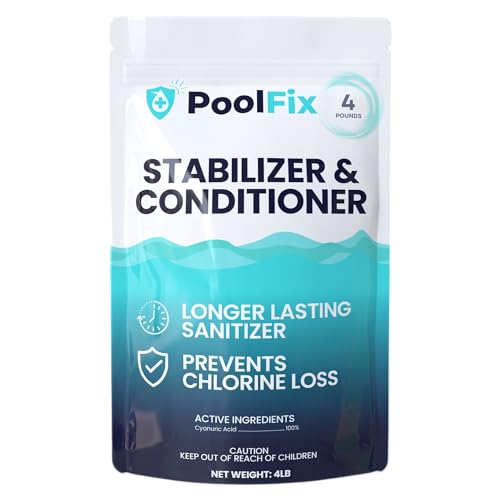
Cyanuric acid (often called CYA or pool conditioner) acts like sunscreen for your chlorine. UV rays from full sun can chew through a large percentage of your free chlorine in a single afternoon, and CYA buffers that loss so your sanitizer lasts longer between doses. PoolFix packages it in a 4 lb resealable bag, which is enough to handle a typical residential start-up dose and a couple of top-ups.
The resealable bag is a thoughtful touch, since loose stabilizer powder tends to clump and absorb moisture if the original container is compromised. Keeping it sealed between uses preserves the dose integrity.
A Few Highlights
- Sun-exposed outdoor pools get the most measurable benefit
- Resealable bag protects the powder from moisture and clumping
- 4 lb size covers a fresh fill and a few seasonal top-ups
Honest Caveats
- Dry powder dissolves slowly without proper circulation, so it can sit at the bottom if you just toss it in
Key Specs
Who Will Love This
Pool owners in sunny climates who find themselves adding chlorine daily during peak summer.
Look Elsewhere When
For a liquid alternative that mixes faster, the AquaDoc Saltwater Pool Stabilizer and Conditioner Liquid skips the slow dissolve step.
Phosphates sneak into pool water through fertilizers, leaves, and even swimmer residue. Algae treats phosphates as food, and a saltwater system is not immune. AquaDoc’s concentrated phosphate remover binds those phosphates so they can be filtered out, effectively cutting off the food source before algae can bloom. The 32 oz bottle is concentrated, so a single bottle can stretch through several treatments on a residential pool.
It fits neatly into a spring opening routine, when phosphates tend to be highest after a closed winter. The catch is that phosphate removal works best when paired with good circulation, so running the pump during and after treatment is part of the deal.
A Favorable Mix
- Concentrated format reduces how much liquid you need to handle per dose
- Targets the underlying phosphate level rather than the algae symptoms
- Designed for saltwater systems specifically
Points To Keep In Mind
- Phosphate removers work best alongside adequate pump runtime, so they aren’t a set-and-forget fix
Right Fit For
Saltwater pool owners who do spring openings in leafy yards or near landscaping that feeds phosphates into the water.
Another Choice May Suit
For general metal and mineral control rather than phosphate focus, the GLB Sequa-Sol targets a broader problem set.
Sunblock, body oils, hair products, and cosmetics all wash off swimmers and into the water. Enzymes break down that non-living organic buildup before it has a chance to clog filters, leave surface films, or feed bacteria. AquaDoc’s enzyme formula targets that layer of residue, which is a different problem from the mineral scale the other picks on this list handle.
Think of it as the cleanup crew for what humans bring into the pool. In households with frequent swimmers or kids who wear sunscreen daily, the difference in water line cleanliness and filter loading is the most visible payoff.
Notable Gains
- Targets non-living organics that sequestering agents don’t address
- Reduces visible waterline residue from lotions and oils
- Lightens the load on the filter between deep cleanings
Small Caveats
- Enzymes do not substitute for mineral control; you still need a sequestering agent for calcium and metals
- Effectiveness drops if dosing becomes irregular, so weekly habits pay off
Who Should Grab It
Saltwater pool owners in households with daily swimmers where lotions and oils are a constant input.
A Better Fit Elsewhere
For a true sequestering agent on mineral control, the GLB Sequa-Sol 1-Gallon Sequestering Agent is purpose-built for that role.
Sequa-Sol is the workhorse of this list. It’s a fast-acting sequestering agent that holds iron, manganese, copper, and calcium in solution so they don’t react with other water chemistry or deposit on your surfaces. The 1-gallon jug is sized for full-pool treatment, whether you dose on start-up or as part of a regular maintenance program.
Compatibility is the headline feature here. Sequa-Sol works with chlorine, bromine, biguanide, ozone, and salt water sanitizing systems, so it slots into almost any residential setup. Compared to PristineCheck, it’s broader in scope and not tied to a single brand ecosystem.
Key Advantages
- Works across chlorine, bromine, biguanide, ozone, and salt systems
- Targets iron, manganese, copper, and calcium in one formula
- 1-gallon size suits full-pool dosing and ongoing maintenance
Worth Bearing In Mind
- Heavier jug requires careful storage to avoid spills
- Full gallon may be more than casual users with smaller pools need
- Sequestrants break down over time, so consistent re-dosing is part of the routine
Key Specs
Made For
Owners of large inground pools with broad-spectrum mineral concerns, especially those using non-chlorine sanitizing systems.
Swap It Out When
Spa owners will find a smaller-format liquid like SpaGuard Stain & Scale Control easier to handle for the smaller water volume.
Liquid cyanuric acid sidesteps the slow dissolve problem of the dry form. AquaDoc’s 128 oz bottle is a single-jug pour-and-circulate option for saltwater pool owners who want chlorine to hold up under full sun without spending a day watching granules melt in the skimmer. The trade-off is volume: it’s a sizable jug, so you need shelf space to store it.
The payoff shows up in the swim season, where consistent CYA levels let your chlorine last longer between additions, which is the kind of efficiency saltwater owners tend to care about most.
The Good Stuff
- Liquid form mixes in immediately, no slow dissolve step
- 128 oz size covers a fresh fill with margin for top-ups
- Designed for saltwater systems where UV exposure is a constant
Possible Compromises
- Large jug is heavy and harder to measure precisely for small top-ups
- Only useful for chlorine stabilization, not mineral control
Perfect Match For
Saltwater pool owners who prefer liquid dosing over dry granules and have the storage space for a gallon-plus container.
Not Your Match When
If shelf space is tight, the dry cyanuric acid in PoolFix’s 4 lb resealable bag takes up less room per dose.
Choosing A Sequestering Agent That Fits Your Water
Start with your water source, since fill water is where most mineral problems originate. Well water typically carries iron and manganese, while municipal supplies tend to run hard on calcium. Matching the formula to the mineral in your water makes the bottle work harder per dose.
Next, think about your sanitizing system. Saltwater pools, biguanide systems, and ozone setups each have a slightly different chemistry profile, and some sequestering agents are more compatible than others. A broad-spectrum option like the GLB Sequa-Sol handles most setups, while spa-specific liquids are tuned for hot tub temperatures.
Container size and format matter more than they seem. Dry stabilizers need circulation to dissolve, liquid versions mix fast but weigh more, and multi-packs make sense for spas with frequent refills. Match the format to how you actually dose: a forgetful weekly routine favors liquids, while occasional top-ups can ride on dry formats.
Finally, plan for the season, not just the start. A sequestering agent’s effect fades as the chemistry reacts and the product gets consumed, so re-dosing through the season matters more than any single initial pour. A gallon jug or 6-pack that looks like overkill in spring often ends up being the right size by fall.
Where Shoppers Go Wrong
The most common slip is treating a clarifier like a sequestering agent. They look similar and live in the same aisle, but they solve different problems. A clarifier pulls fine particles together so the filter can catch them, while a sequestering agent locks metals and minerals in solution so they don’t deposit. A cloudy pool often needs both, just not from the same bottle.
The second trap is dosing once and assuming the job is done. Sequestering agents are consumed over time, so a single pour at opening leaves you exposed by midsummer. The smarter approach is a smaller start-up dose followed by a steady maintenance schedule that matches your water volume and bather load.
Frequently Asked Questions
What does a sequestering agent actually do for a pool?
It binds to calcium, iron, copper, and other reactive minerals in the water and keeps them dissolved, so they pass through the system instead of staining surfaces or scaling up equipment.
Can I use a spa sequestering agent in my pool?
It works in principle, but you’ll run out of product fast because pools hold far more water. A larger container like a 1-gallon jug makes more sense for full-pool dosing.
How often should I re-dose during the season?
Most manufacturers recommend a weekly maintenance dose after the initial treatment, since the sequestering effect fades as the chemistry reacts. Heavy use or high-mineral water may call for more frequent applications.
Is cyanuric acid the same thing as a sequestering agent?
No. Cyanuric acid stabilizes chlorine against UV loss, while sequestering agents target minerals. Both belong in a well-rounded pool care routine, but they solve different problems.
Do I need a phosphate remover if I already use enzymes?
They overlap but aren’t interchangeable. Enzymes break down non-living organics like lotions and oils, while phosphate removers specifically target the food source for algae. The two often work well together in saltwater pools.
Wrap Up
The right sequestering agent depends on your water, your sanitizer, and how much attention you want to give the routine. Start by identifying your main mineral threat, pick a format that matches your dosing habits, and plan to re-dose through the season rather than relying on a single pour. A small bottle of prevention tends to be far cheaper than a service call for a scaled heater or a stained plaster finish.


