

Salt is the quiet engine behind any chlorine generator pool. Without the right grade in the water, your cell works harder, your water turns cloudy, and your eyes sting on the first hot day of the season. Forty-pound bags are the workhorse size for most residential pools, big enough to handle a full start-up, small enough to drag to the edge without throwing out your back.
You have two real decisions to make. The first is whether you want actual pool-grade salt or a chlorine alternative like tablets or dichlor shock, both of which still arrive in 40-pound formats. The second is which brand you trust to dissolve cleanly, leave no residue, and play nicely with your specific cell. This guide walks through seven solid options, starting with pure generator salt and finishing with a fast-dissolving shock for routine maintenance.
The Lineup, Simplified
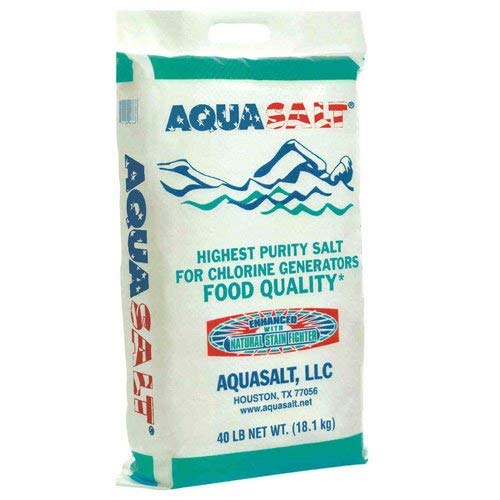
AQUASALT Swimming Pool and Spa Chlorine Generator Salt 40 lbs

AQUASALT Chlorine Generator Salt Qty. 2 40 lb Bags

Pool Shark 3-Inch Chlorine Tablets 40 lbs 90% Active

Leslie’s Chlor Brite Dichlor Pool Shock 40 Pounds

Morton Salt F134660000 Pro Pool Salt 40 lb

Swimming Pool Salt 40 lb Bag

Morton Salt 3460 Pool Salt 40 lb
Taking A Closer Look At The Options
AQUASALT sets the baseline for what a generator-friendly salt should look like. It carries USP-grade certification, which is the same purity standard used for table salt, and the entire bag is purpose-built for chlorine generator cells rather than water softeners. For most new pool owners, that distinction is the whole game. A salt cell reacts harshly to impurities like iron, manganese, or anti-caking agents, and the wrong bag will stain plaster and shorten the cell’s life.
You’ll do the standard pour-and-brush routine, spreading the salt across the deepest part of the pool and brushing any piles until they dissolve. The crystals break down quickly under normal circulation, and the bag itself is the standard 40-pound size that most residential start-ups demand. Compared to the Morton offerings later in this list, AQUASALT leans further into the “lab-pure” story.
What Earns Its Place
- USP-grade purity designed specifically for salt cells, reducing the risk of staining and buildup
- Evaporated, food-grade manufacturing process most pool owners find reassuring
- Single 40 lb bag is the right size for typical residential start-ups and top-offs
- Dissolves cleanly when broadcast across the deep end and brushed periodically
Things To Consider
- Not intended for human consumption, so storage matters if you have curious kids
- Heavier 40 lb bag means a tough carry to the deep end for smaller households
Who It Suits Best
First-time salt pool owners who want the cleanest possible start without learning every nuance of salt chemistry the hard way.
Where Another Pick Suits Better
Anyone with a large pool that needs a full opening plus several top-offs should grab the two-bag AQUASALT Qty. 2 pack instead.
The two-bag AQUASALT pack is essentially the same product as pick 1, just doubled. That makes it the practical choice for anyone with a 20,000+ gallon pool, a fresh fill from the tap, or a seasonal opening in cooler water where dissolution runs slow. You also get the same USP-grade certification, so the cell-friendly profile carries over from the single bag.
For most suburban pools doing a full spring start-up, 80 pounds is right in the sweet spot. The trade-off is storage: 80 pounds of salt takes up real space in a garage or shed, and you’ll want to keep the bags off concrete floors to prevent moisture wicking. If you have the room and the need, this is the more efficient way to buy the same trusted salt.
Features That Help
- Two-bag format suits larger pools, fresh fills, and full seasonal openings
- Identical USP-grade purity to the single-bag version, so no quality compromise
- Same easy broadcast and brush routine, with more total coverage per order
Worth Noting
- At roughly 80 pounds total, you’ll want a hand cart or a strong helper to move both bags to the poolside
- Overkill for small above-ground pools that only need a partial top-off each season
Made For
Owners of larger in-ground pools who would otherwise need to place two single-bag orders back to back.
Skip It When
You’re topping off a smaller above-ground pool, where the single-bag AQUASALT is plenty.
Pool Shark’s 3-inch tablets aren’t salt in the generator sense, but they still arrive in a 40-pound format and serve a large chunk of residential pool owners. Trichlor tablets (short for trichloro-s-triazinetrione, a stabilized chlorine compound) dissolve slowly and feed a steady stream of chlorine into your water, which is why tablet chlorination has stayed popular for decades. The 90% available chlorine figure is solid for this category.
You load these into a floater, a skimmer, or an automatic chlorinator, and the water does the rest. They’re a great match for owners of hot tubs, smaller above-ground pools, and saltwater pools that still want a tablet backup during heavy use. If your pool runs entirely on a salt cell, you don’t need this product, but for everyone else, the convenience is hard to overstate.
Where It Helps
- Slow-dissolving 3-inch format lasts days per tablet, cutting down on hands-on maintenance
- Works in floaters, skimmers, and automatic chlorinators alike
- 90% available chlorine from 99% trichlor means a concentrated dose per tablet
- Compatible with inground, above-ground, saltwater, and hot tub setups
Trade Offs
- Trichlor lowers pH over time, so you’ll test and adjust alkalinity more often than with a salt cell
- Not a substitute for actual pool salt, so saltwater cell owners don’t need it as a primary sanitizer
Best Suited To
Pool and spa owners running a floater or chlorinator who want a low-effort, set-it-and-forget-it sanitation routine.
Look Elsewhere When
You run a true saltwater chlorine generator and want a salt that actually feeds the cell, where the AQUASALT or Morton options fit better.
Leslie’s Chlor Brite is granular dichlor (sodium dichloroisocyanurate, a fast-dissolving, stabilized chlorine) rather than pool salt, but it solves a real problem for residential owners: shocking the water quickly. Where trichlor tablets feed chlorine slowly over days, dichlor dissolves on contact and delivers a measured 55% available chlorine to the water almost immediately. That’s the tool you reach for when the pool turns green, after a storm, or before a big weekend of swim traffic.
You broadcast the granules across the surface, run the pump, and within hours the chlorine residual is back where you want it. The product is stabilized, so UV rays from afternoon sun won’t burn off your dose before it has a chance to work. It’s safe across all pool and spa types, and because it dissolves fully, you’re not left scrubbing residue off the floor.
Where It Delivers
- 99% sodium dichlor with 55% available chlorine for a serious, fast-acting dose
- Stabilized formula holds up under direct sunlight during the shock window
- Works across all pool and spa types, including vinyl, plaster, and fiberglass
- No residue and no bleaching when used at recommended levels
Honest Caveats
- Not a salt, so saltwater cell owners use this only for occasional shock, not daily sanitation
- Adding too much will push cyanuric acid (the chlorine stabilizer) higher over time, which can reduce chlorine effectiveness
Who Should Grab It
Pool owners who shock their water regularly and want a fast-dissolving, residue-free granular option from a known retail name.
Consider Something Else When
You’re buying for a brand-new saltwater pool that just needs start-up salt, where the AQUASALT option is the right call.
Morton is the name most pool owners grew up seeing in their garage, and the Pro Pool Salt 40-pound bag keeps that brand trust intact. It’s specifically designed for salt water chlorinators and contains no additives, which matters because anything extra in the bag ends up in your cell. Morton also markets this version with a faster dissolve rate than many competing salts, which is genuinely useful on a cool spring morning.
The honest read is that the Pro Pool Salt is a no-drama bag. It does what you want, when you want it, without the lab-pure USP claims. For households that already trust Morton from the kitchen pantry, that familiarity carries over. The trade-off is that you don’t get the same explicit certification language as AQUASALT, so owners of higher-end cells sometimes cross-shop between the two.
Useful Strengths
- No additives, so nothing in the bag interferes with your salt cell’s chemistry
- Fast dissolve rate, especially in warmer water, helps you get back to swimming sooner
- 40 lb size fits the standard residential start-up and seasonal top-off cycle
Points To Note
- Marketed specifically for chlorinators, not water softeners, so don’t repurpose the bag elsewhere
- Lacks the explicit USP certification that AQUASALT carries, which may matter to detail-oriented owners
The Right Fit
Pool owners who already buy Morton for the kitchen and want the same brand handling their pool’s salt needs.
A Better Fit Elsewhere
Owners chasing explicit USP-grade certification on the label will find more confidence in the AQUASALT single bag.
The Chemical Equipment Labs 40-pound bag plays the minimalist card. There’s no big brand recognition, no USP marketing, just a clean pool salt with no additives. The pitch is straightforward: it’s a natural source, it’s affordable, and it works in any standard salt system. For owners who don’t want to overthink the bag in their garage, that simplicity is the appeal.
You get the same routine as any other generator salt. Pour, broadcast, brush until it dissolves, then let the cell do its job. The trade-off versus a Morton or AQUASALT is the brand track record. Morton has decades of retail presence, and AQUASALT has a clear certification story. This bag relies on the category itself rather than a specific reputation.
Positive Points
- Additive-free formulation keeps your salt cell running without extra mineral buildup
- Affordable entry point for first-time saltwater pool owners
- Standard 40 lb size matches typical residential demand
Room For Improvement
- Less brand recognition than Morton or AQUASALT, which matters if you want long-term consistency
- No explicit certification language on the label, so detail-oriented owners may want more reassurance
Whose Shelf It Belongs On
New saltwater pool owners who want a clean, no-frills salt at a sensible size without paying for brand cachet.
Not Your Match When
You prefer a nationally known brand with decades of retail trust, where the Morton 3460 bag delivers that familiarity.
The Morton 3460 is the long-running sibling to the Pro Pool Salt covered earlier, and for many pool owners it’s the bag they’ve bought every spring for a decade. It shares the same baseline pitch: high purity, no additives, made specifically for salt water chlorinators, and not recommended for water softeners. The 40-pound size is the residential standard, and the dissolve rate holds up for typical spring and summer conditions.
This is the bag to grab when you want the predictable, low-fuss option. There are no surprise formulations or marketing pivots, just a steady bag of pool salt that does the job. If you’ve used it before and liked the result, the simplest upgrade path is the same bag on your porch again.
Useful Touches
- High-purity formulation that won’t shorten your salt cell’s lifespan
- Fast-dissolving rate for routine seasonal top-offs
- 40 lb size matches standard residential demand across most pool sizes
Small Caveats
- Not meant for water softener use, so don’t let a handyman accidentally reroute the bag
- Storage matters: keep it dry and off concrete so the crystals don’t clump before you use them
Perfect Match For
Long-time pool owners who want the same dependable bag they’ve been buying for years without surprises.
Reach For A Different Pick When
You’re starting a new saltwater pool and want explicit USP-grade certification on the label, where AQUASALT fits more naturally.
Choosing the Right 40 lb Pool Salt for Your Setup
Match the Salt to Your System, Not Just the Bag
The single biggest decision is whether your pool runs on a salt cell or on tablet and shock chemistry. Salt chlorine generators need a steady 3,000 to 3,500 ppm of sodium chloride in the water, which the cell converts into chlorine through electrolysis. For those pools, any of the generator-specific salts from AQUASALT or Morton will work. The trade-off comes down to certification language, brand familiarity, and how much you want to spend per bag.
Pools without salt cells can still use 40-pound formats, but they’re reaching for trichlor tablets like Pool Shark or dichlor shock like Leslie’s Chlor Brite instead. Both deliver chlorine, but they do it through different mechanisms and require different handling routines.
Dissolve Rate and Temperature Matter More Than You’d Think
Cold water slows everything down. A salt that dissolves in a few hours at 80°F can take a full day at 60°F, which is why spring openers sometimes leave white piles sitting on the pool floor for what feels like forever. The honest move is to broadcast the salt across the deepest part of the pool, run the pump on high, and brush repeatedly until every crystal is gone. Skipping the brushing step is how piles end up staining plaster.
Purity and Additives Are the Hidden Differentiator
Food-grade and USP-grade salts go through extra purification steps that water softener salt skips entirely. The extra cost pays for itself in the form of longer cell life and fewer stains on plaster and vinyl. Anti-caking additives, which some lower-grade salts include, can also leave residue on tile lines and inside the cell, so they belong in the kitchen pantry, not in the pool.
What Most Shoppers Get Wrong Before Buying
Common Shopping Slip Ups
The most frequent mistake is buying water softener salt for a chlorine generator. The two products look identical in the bag, but softener salt contains mineral additives that can cloud water, stain surfaces, and shorten a cell’s life. Another slip is underestimating the volume a fresh fill actually needs. Most residential pools between 15,000 and 20,000 gallons run through roughly 400 to 500 pounds of salt on a full start-up, so a single 40 lb bag is rarely enough on its own.
Where The Extra Money Goes
The price gap between a budget 40 lb bag and a USP-grade bag is real, and the upgrade usually buys three things. First, more rigorous purification that removes trace metals. Second, a faster dissolve rate that gets you back in the water sooner. Third, brand accountability, meaning a known name standing behind the product if the chemistry ever goes sideways. For larger pools and owners who don’t want to babysit the salt level, the upgrade usually pays for itself within a season.
Frequently Asked Questions
How much salt does a typical residential pool actually need?
Most pools between 15,000 and 20,000 gallons use roughly 400 to 500 pounds of salt for a full start-up, and a 40 lb bag handles one of those plus several small top-offs. Always test the water first with a salt test strip or a Taylor test kit before adding more.
Can I use water softener salt in a chlorine generator pool?
You should not, because water softener salt contains mineral additives that can cloud the water and shorten your cell’s lifespan. Stick with pool-specific or USP-grade salt for any generator system.
What’s the difference between trichlor tablets and dichlor shock?
Trichlor is a slow-dissolving tablet used for daily or weekly chlorine feeding, while dichlor is a fast-dissolving granular used for quick shocks and recovery. Both contain chlorine, but they serve different routines.
How do I know when my pool needs more salt?
Most salt cells display a “low salt” indicator, and your test kit should read between 3,000 and 3,500 ppm for most residential systems. Test after heavy rain, a fresh fill, or a major backwash cycle.
Is it safe to swim right after adding salt to the pool?
You can swim almost immediately after the salt fully dissolves, which usually takes a few hours with the pump running. Brushing speeds up the dissolve and gets you back in the water faster.


