

A cloudy pool turns a backyard into a maintenance headache fast. Diatomaceous earth (DE) filter media traps particles down to a few microns, leaving water noticeably clearer than sand alone, and it works with both DE-specific filters and some sand setups. Choosing the right grade and matching it to your filter type matters more than most shoppers realize.
How The Shortlist Stacks Up

Minerals DE25BOX Diatomaceous Earth Pool Filter D.E.
Clorox Pool & Spa D.E. Media + Filter Aid 24 lb

DPM Celatom Diatomaceous Earth Filter Powder 25 lbs

Minerals DE Swimming Pool Filter Media 100 lb

HTH 67121 D.E. Filter Aid 10 lbs

EasyGo Celatom DE Pool Filter Aid 25 lb

DPM PUREX DE Grid Replacement Set (48 Sq Ft)

Unicel FS-2004 48 Sq Ft DE Grid Set (2 Pack)
A Closer Look At Each Pick
For most homeowners running a residential DE filter, this 25-pound bag of Dicalite DE is the benchmark. The powder is mined from the fossilized exoskeletons of diatoms (microscopic algae), giving it a porous structure that traps particles down to 3 to 5 microns. That level of detail is the real reason DE outperforms sand in everyday pool use.
It works with both above-ground and in-ground DE filter systems, so you don’t need to worry about cross-compatibility. The 25-pound size hits a practical middle ground for seasonal top-ups, and the brand has long shelf stability when stored dry. For most backyards, this is the dependable starting point.
Notable Upsides
- Filters down to 3 to 5 microns, catching fine silt that sand leaves behind
- All-natural composition with no added clumping agents
- Compatible with both above-ground and in-ground DE filter setups
- 25-pound bag suits a typical seasonal recharge for residential pools
- Widely used in the pool service trade, so tips and tutorials are easy to find
Trade Offs
- 3 to 5 micron rating is solid but not the finest available in this category
- Requires careful handling and a dust mask during recharging to avoid inhaling fine particles
Quick Facts
Made For
Homeowners with a standard DE filter who want a trusted, broadly compatible media for routine seasonal maintenance.
Consider Something Else When
Pool owners chasing the clearest possible water should consider DPM Celatom Diatomaceous Earth Filter Powder 25 lbs, which filters down to 2 microns.
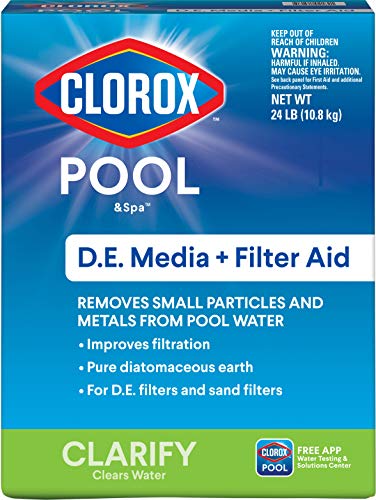
Clorox’s D.E. Media + Filter Aid is built for pool owners dealing with more than just dirt, since it also targets metals suspended in the water. Metals like copper and iron are common after a fill from certain wells and leave staining on plaster if left unfiltered. Pairing this with a DE grid setup helps keep both clarity and surface staining in check.
Unlike the Dicalite bag in pick 1, this one is also labeled for sand filters, so you can use it as a filter aid on systems that aren’t dedicated DE units. In our view, that flexibility is the main reason to reach for it. The 24-pound pail handles the kind of metal-tinted water that regular DE leaves behind.
What Makes Sense
- Targets small particles and dissolved metals in a single step
- Labeled for both DE and sand filter systems
- 24-pound pail suits a full recharge or larger top-up
Points To Note
- Specific micron rating isn’t published, so it’s harder to compare directly to other DE grades
- Heavier 28-pound shipping weight can bump delivery costs on some orders
Right Fit For
Owners of sand filters who want to add DE-style clarification, or anyone with well water carrying iron or copper traces.
Swap It Out When
Anyone running a standard DE filter and chasing the finest micron rating should pick DPM Celatom Diatomaceous Earth Filter Powder 25 lbs instead.
Discount Pool Mart packages EP Minerals’ Celatom DE in a 25-pound bag with a filter scoop included, which is a small but useful touch. Celatom has built a strong reputation among service techs, and the published 2-micron filtration figure is finer than what the Dicalite grade in pick 1 offers. If the difference between 2 and 5 microns sounds small on paper, it shows up in the water.
The included scoop simplifies the recharging process, so first-timers don’t need to guess the right amount. You may find that this media produces noticeably clearer water in well-balanced pools, especially after a heavy pollen week. For shops and homeowners who want top-end clarity, this is the one to beat.
Everyday Wins
- 2-micron filtration, finer than most residential DE grades
- Includes a filter scoop, simplifying the recharge routine
- Celatom is widely used by pool service professionals
- Helps reduce reliance on clarifiers and shock treatments when the pool is balanced
Worth Bearing In Mind
- Finer media can clog faster in heavily used pools, requiring more frequent backwashing
- Slightly higher cost per pound than entry-level DE
Feature Snapshot
Best Suited To
Pool owners chasing the clearest possible water who don’t mind a more attentive backwashing schedule.
Skip It When
Large-volume users with heavy bather loads will find Minerals DE Swimming Pool Filter Media 100 lb more cost-effective per pound.
The 100-pound Dicalite bag is the same trusted grade as the 25-pounder in pick 1, just at a different scale. For large residential pools, commercial setups, or anyone running a service route, the bulk format reduces how often you reorder. The 3 to 5 micron rating is identical, so you’re not trading clarity for volume.
Storage becomes a real consideration at this size, since 100 pounds of powder needs a dry corner and a sealed container. For pool pros or homeowners with multiple bodies of water, though, the math works out clearly in favor of buying in bulk. Compared to Clorox’s 24-pound pail in pick 2, this one is aimed at throughput rather than metal removal.
Features That Help
- Same 3 to 5 micron rating as the smaller Dicalite bag
- 100-pound format suits commercial pools or multi-pool properties
- Lower per-pound cost when buying in volume
- Compatible with standard DE filter grids
Potential Compromises
- Requires significant dry storage space and a sealed container
- Heavier handling makes recharging a two-person job in most cases
Whose Shelf It Belongs On
Pool service technicians, commercial property managers, and homeowners with very large residential pools who go through DE quickly.
Look Elsewhere When
Single-family backyard pools on a normal schedule will get more value out of the smaller DPM Celatom Diatomaceous Earth Filter Powder 25 lbs.
HTH’s 10-pound pail is the most approachable entry point on this list. For first-time DE users, a smaller bag means less commitment and a shorter learning curve. HTH has a long track record in residential pool care, so pairing this filter aid with the rest of the HTH product line keeps the chemistry consistent.
The smaller format is also handy for spot treatments between full recharges, especially after a storm or a heavy bather weekend. Compared to the DPM 25-pounder in pick 3, this trades some economy for easier handling. In our view, that’s a fair swap for anyone just getting comfortable with DE.
The Practical Payoff
- Compact 10-pound size is easy to lift, pour, and store
- Lower upfront commitment for first-time DE users
- Useful for partial top-ups between full recharges
A Few Limitations
- Not enough media for a full recharge on most residential pools
- Per-pound cost is higher than the larger 25 or 100-pound options
Who Should Grab It
New DE users who want to try the format without committing to a large bag, or anyone needing small top-ups between seasonal services.
Reach For A Different Pick When
Owners with a standard residential pool who want a complete recharge in one buy should choose Minerals DE25BOX Diatomaceous Earth Pool Filter D.E. instead.
EasyGo Product sources from EP Minerals’ Celatom line, which has been a long-time standard in pool and spa filtration. The 2-micron filtration rating matches the DPM offering in pick 3, so the underlying media quality is the same. The difference comes down to packaging, branding, and how each retailer positions the product.
You may find this 25-pound format a good fit for a standard residential pool where the 100-pound Dicalite bag in pick 4 is overkill but the 10-pound HTH pail in pick 5 is too small. EP Minerals’ DE and perlite (a similar volcanic filter aid) are valued for their chemical stability in pool water, which keeps filter media from reacting with sanitizers.
Everyday Advantages
- Celatom source, an industry-standard pool filtration media
- 2-micron filtration for fine particle capture
- 25-pound bag fits a typical residential seasonal recharge
- Chemically stable in standard pool water chemistry
Softer Spots
- Brand recognition is smaller than Dicalite or HTH, so community troubleshooting threads are fewer
- Scoop is not included, unlike the DPM bag in pick 3
At A Glance
Perfect Match For
Residential pool owners who want a Celatom-grade media in a practical mid-size bag and don’t need an included scoop.
Not Your Match When
Anyone who values a bundled scoop for easier dosing should pick DPM Celatom Diatomaceous Earth Filter Powder 25 lbs instead.
Shifting gears, this set isn’t filter media at all, it’s the grid set that holds the DE inside the filter housing. DPM’s PUREX-compatible replacement includes 8 large upside-down grids with a heavy-duty reinforced core, sized for 48 square feet of media coverage. For owners of Pentair PUREX 2048 or 4048 filters, this is a direct-fit rebuild.
Available in three heights (18, 24, and 30 inches), the 24-inch version shown here matches many residential PUREX models. Made in the USA, which is a nice bonus for shoppers who prioritize domestic manufacturing. You may find that replacing aged grids restores flow rate and backwash efficiency that has slowly degraded over the years.
The Upside
- Direct-fit for Pentair PUREX 2048 and 4048 filter housings
- Heavy-duty reinforced core adds rigidity during backwashing
- Three height options cover the most common PUREX configurations
- Manufactured in the USA
Honest Caveats
- Only fits Pentair PUREX SMBW models, not other DE filter brands
- Full set of 8 grids is a more involved replacement than topping off media
Technical Sheet
Built With In Mind
Owners of Pentair PUREX 2048 or 4048 DE filter housings whose original grids are worn or torn.
A Better Fit Elsewhere
Owners of American, Hayward, Pac-Fab, or Sta-Rite filters should pick the Unicel FS-2004 48 Sq Ft DE Grid Set (2 Pack) for broader brand compatibility.
Unicel’s FS-2004 set is the cross-brand alternative to the DPM PUREX set in pick 7. The 48 square feet of media area, combined with a high yarn count of fine denier fibers (a measure of fiber fineness that affects filtration tightness), helps DE cake evenly across the grid surface. That caking behavior is what makes the actual filtration happen.
Compatibility covers American, Hayward, Pac-Fab, Sta-Rite, Astral, and similar brands, so this is the safer choice when the filter brand is older or the label has faded. The grid cloth is designed to reduce flow resistance, which extends the time between backwashes. For most pools, that’s a real convenience win.
Key Advantages
- Broad brand compatibility across major DE filter manufacturers
- Fine denier fibers improve DE caking for better filtration
- Reduced flow resistance extends backwash cycles
- Two-pack format covers a full filter in one purchase
Practical Considerations
- FS-2004 designation must be matched against the existing filter specs before ordering
- Replacement requires disassembly of the filter housing, which some owners prefer to leave to a service tech
Key Product Details
Who Will Love This
Owners of major-brand DE filters who need replacement grids without tracking down brand-specific parts.
Where Another Pick Suits Better
Pentair PUREX owners will get a more precise fit from DPM PUREX DE Grid Replacement Set (48 Sq Ft), which is purpose-built for those housings.
Picking The Right DE Media And Equipment
A DE filter works by coating internal grids with a thin layer of powder, then passing water through that cake. The micron rating tells you how small a particle the system can trap, and lower numbers mean clearer water but more frequent recharges. Match the media to your filter type first, then worry about grade.
Residential pools typically need 4 to 6 pounds of DE for a full recharge, depending on filter size. Larger commercial setups scale up from there, which is why bag size matters as much as filtration quality. Storage also plays a quiet role: DE pulls moisture from the air, so a sealed container in a dry spot keeps the media usable across multiple seasons.
Picking the right DE grade and matching it to your filter type matters more than most shoppers realize. Micron ratings drive clarity. 5-micron media is plenty for routine residential use, but 2-micron media produces noticeably better water in well-balanced pools. If your filter housing has older grids, replacing them before switching to a finer media prevents unnecessary pressure buildup.
DE isn’t a sanitizer, so it works alongside chlorine, bromine, or salt systems rather than replacing them. For pools with metal content in the fill water, a media labeled for metal removal adds a useful layer of protection. Always wear a dust mask when handling dry DE, since the fine particles irritate lungs during pouring.
Key Considerations Across These Picks
Pitfalls Shoppers Hit
The most common mistake is buying DE for a filter that isn’t actually a DE system. Sand filters and cartridge filters need different media entirely, even if some products label themselves as “filter aid.” Check your filter’s manual for the manufacturer-specified media type before ordering, since using the wrong one can clog the system or reduce flow.
Another slip-up is ignoring grid condition. Fresh DE on worn grids is like new paint on a cracked wall: the underlying problem stays. If the filter housing is more than five to seven years old, a grid replacement (like the DPM PUREX set or the Unicel FS-2004) often improves results more than a media upgrade alone.
Where The Extra Money Goes
Higher-tier DE media, like Celatom grades, earns its premium through finer filtration and more consistent particle size. That translates to clearer water and slightly less reliance on clarifier chemicals, which adds up over a swimming season. The jump from a 5-micron grade to a 2-micron grade is the most visible upgrade, though it does mean more frequent recharges in heavily used pools.
For grid sets, the upgrade path runs toward broader compatibility and stronger core construction. The Unicel set costs more than some direct-fit alternatives, but the cross-brand flexibility pays off if the filter brand is unusual or older. For most homeowners, though, a direct-fit set like the DPM PUREX version is the smarter spend.
Frequently Asked Questions
How often should DE filter media be replaced?
A full recharge is needed after each backwash, when the pressure gauge rises 8 to 10 psi above the clean reading. Spot additions between backwashes extend media life and keep filtration steady.
Can DE media be used in a sand filter?
Some products, like the Clorox Pool & Spa D.E. Media + Filter Aid, are specifically labeled for sand filter use as a filter aid. Standard DE powder should only be used in filters designed for it.
What is the difference between DE grades?
Filtration rating is the main difference, with finer grades catching smaller particles. Celatom and similar premium grades are valued for consistency, while standard Dicalite grades cover most residential needs at a lower per-pound cost.
How long does a bag of DE last in storage?
Unopened and stored in a dry, sealed container, DE media stays usable for several seasons. Moisture is the main enemy, since wet DE clumps and becomes harder to disperse evenly across filter grids.
Are replacement grids necessary with every media change?
No, grids typically last several years before needing replacement. The DPM PUREX set and Unicel FS-2004 set both replace the full grid assembly when wear, tearing, or reduced flow finally makes it necessary.


